There is a very specific kind of frustration that comes from being exhausted all day and wide awake the moment you’re supposed to sleep.
If you have ADHD, you probably know the pattern. You drag yourself through the morning, promise yourself that tonight will be different, then somehow become strangely alive at 10:47 p.m. Suddenly your brain wants to research something, reorganise something, watch one more episode, reply to the message you avoided all day, or start a project that absolutely did not need to begin at midnight.
From the outside, this looks like poor discipline. From the inside, it often feels like your brain has a broken on/off switch.
But ADHD sleep problems are not just a bad habit. They are often the result of how ADHD affects arousal, dopamine, time perception, emotional regulation and circadian rhythm.
That matters because poor sleep does not simply make you tired. It temporarily weakens the exact brain functions ADHD already makes harder: planning, impulse control, working memory, emotional regulation and sustained attention.
This guide is not going to tell you to “just go to bed earlier.”
If that worked, you would already be doing it.
Instead, I want to help you understand what is happening inside your ADHD brain so sleep stops feeling like another thing you are failing at and starts making biological sense.
📖 Companion guideThis article works as a deeper companion to my bigger guide, “How to Manage ADHD Without Medication: Evidence-Based Strategies That Actually Work.” In that article, sleep is one of the core non-medication strategies. Here, we are going much deeper.
Managing ADHD sleep is not about becoming a perfect bedtime person. It is about protecting the part of your brain that has to carry you through tomorrow.
When you sleep badly, your prefrontal cortex takes a hit. That is the part of your brain involved in planning, decision-making, impulse control, emotional regulation and working memory. In other words, poor sleep does not create a random tired version of you. It creates a version of you with less access to the very tools ADHD already makes difficult to use.
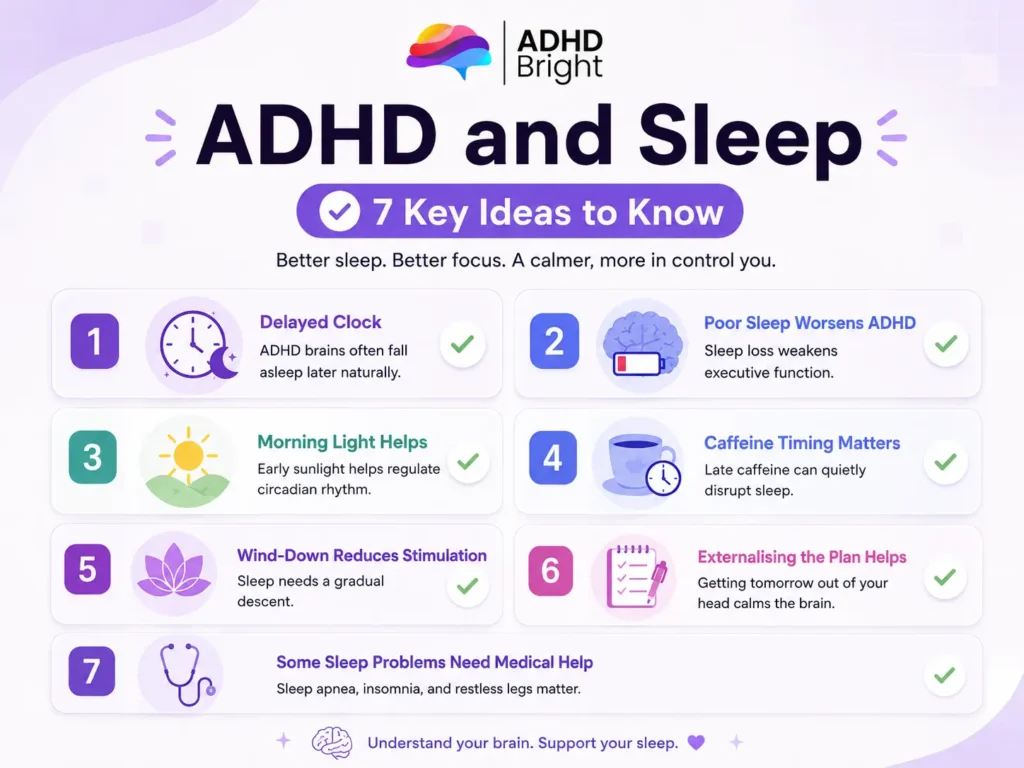
Most sleep advice assumes a fairly predictable brain.
Dim the lights. Put your phone away. Relax. Go to bed.
That advice is not wrong, but for many ADHDers it is incomplete. It ignores the fact that an ADHD brain often becomes more alert when the world finally gets quiet. During the day, you are constantly interrupted by demands, transitions, tasks, noise, messages, people, decisions and responsibilities. At night, when the pressure finally drops, your brain suddenly has space to think. The problem is that it often uses that space to come alive.
That does not mean your brain is trying to sabotage you. It means your arousal system, reward system and internal clock may not be lining up with the schedule your life expects you to follow.
A lot of ADHD sleep struggles fall into a few overlapping patterns:
This is why generic sleep advice can feel insulting. It treats the behaviour as the problem while ignoring the mechanism underneath it.
One of the most important things to understand about ADHD and sleep is that many ADHDers are not simply choosing to stay up late. Their internal clock may genuinely be shifted later.
This is often described as delayed sleep phase or delayed sleep-wake phase disorder, where the body naturally wants to fall asleep and wake up later than conventional schedules allow. Research has repeatedly linked ADHD with evening chronotype and delayed circadian timing, and delayed sleep phase is often described as one of the most common sleep disturbances in adults with ADHD.
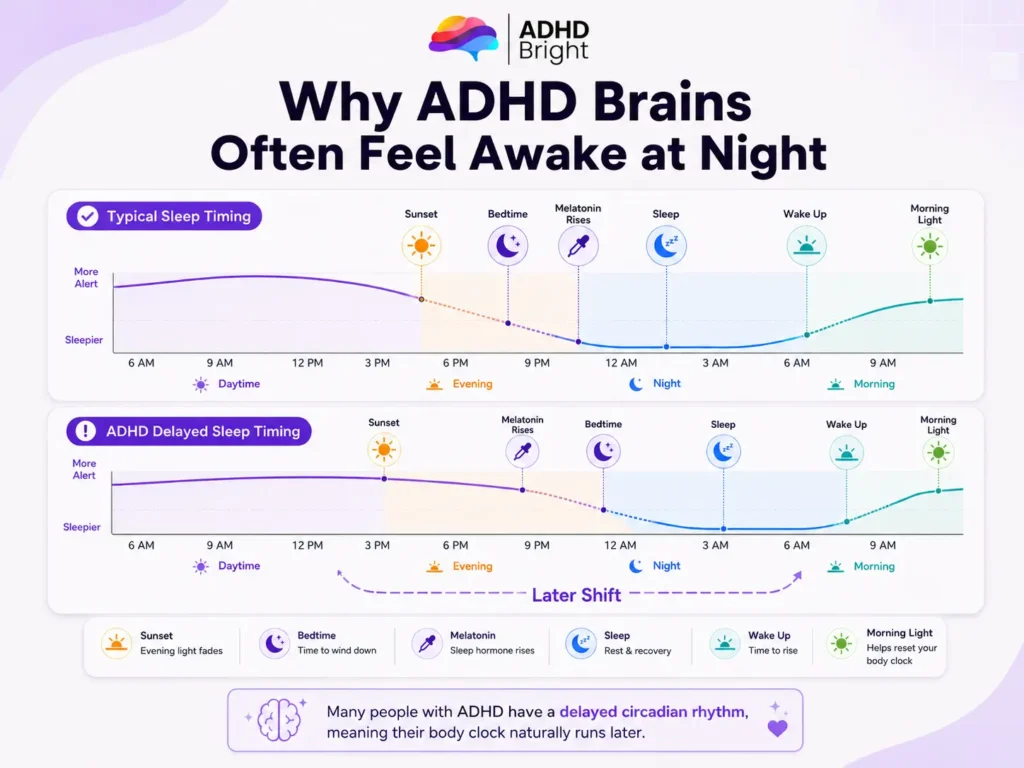
This explains why you can be exhausted at 6 p.m., then somehow not sleepy at midnight.
Sleepiness is not only about how tired you are. It is also about timing.
Your body runs on a roughly 24-hour circadian rhythm that helps regulate alertness, temperature, hormones, digestion and sleep. Light is one of the strongest signals that sets this clock.
The problem is that modern life gives your brain the opposite message. Many of us spend the morning indoors under weak artificial light, then flood our eyes with bright screens at night. To your circadian system, that can look like a dim morning and a bright evening. It is almost the perfect recipe for making a late body clock even later.
This is why morning light matters so much for ADHD sleep. It is not just another wellness habit people repeat because it sounds nice. Natural outdoor light is one of the strongest signals your brain uses to set your circadian rhythm.
Even stepping outside for five minutes can expose your eyes to far more light than indoor lighting ever could, depending on the weather and time of day. That light tells your brain, “The day has started,” which helps your body time the release of melatonin later that night.
I had heard this advice so many times before I actually tried it. For some reason, I either didn’t believe something so simple would work, or I wasn’t willing to take it seriously because it sounded too basic. But when I started going outside in the morning, even just for a few minutes, I noticed a difference that same night. My body felt ready for sleep earlier, and that made me realise morning light was not about becoming a “morning person”—it was about giving my ADHD brain a clear biological signal it had probably been missing for years.
The most important sleep reframe for ADHD is this:
Your prefrontal cortex is one of the brain regions most affected by sleep loss. This is the area involved in planning, decision-making, impulse control, working memory and emotional regulation. Reviews of sleep deprivation research consistently show that sleep loss impairs attention, working memory and executive functions, with the prefrontal cortex being especially vulnerable.
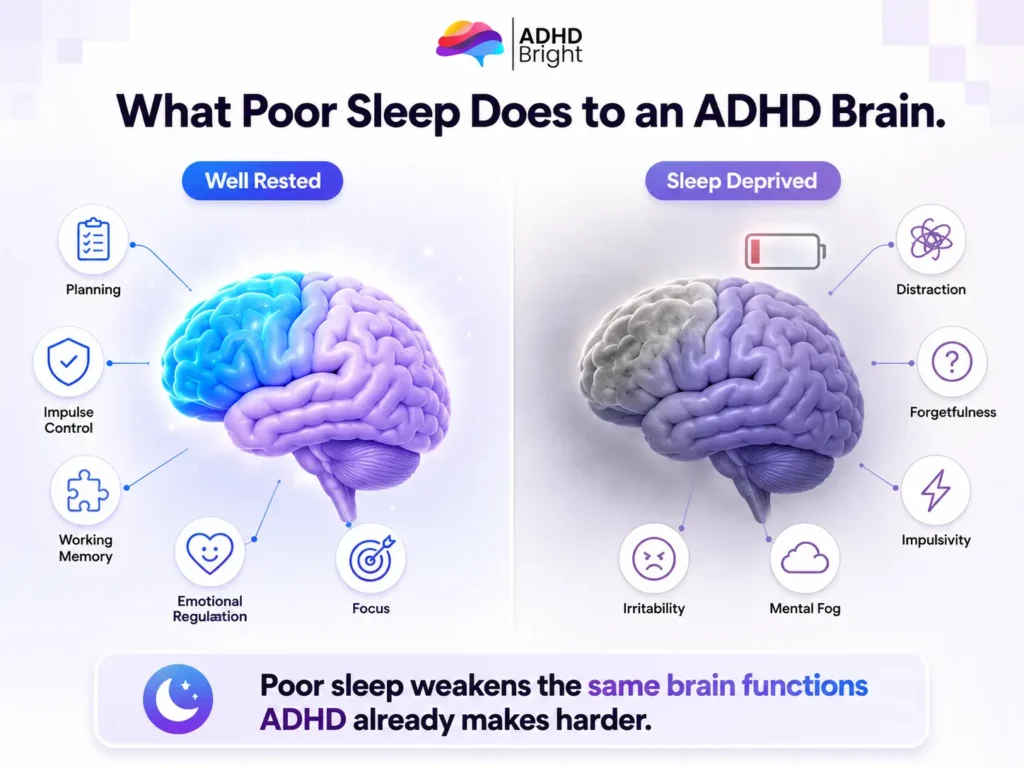
If those functions sound familiar, that is because they are the same functions ADHD already affects.
This is why a bad night can make everything feel dramatically harder the next day. The email you avoided yesterday becomes almost impossible today. The small frustration that would normally annoy you suddenly ruins your mood for hours. The task you planned to do after breakfast disappears from your mind the moment something more stimulating appears.
That is not because you woke up weaker.
It is because you woke up with fewer executive resources.
Think of your prefrontal cortex as the battery that powers your executive functions. Every decision you make, every impulse you resist, every distraction you ignore, every plan you follow and every emotion you regulate uses a little of that battery.
If you have ADHD, you may not necessarily wake up with a smaller battery, but you often drain it faster because your brain has to work harder to perform the same executive tasks. Sleep is how that battery recharges. When you sleep five hours, you do not wake up at 100%. You might start the day at 50 or 60%, then expect yourself to regulate emotions, remember tasks, resist distractions and make sensible decisions for the next sixteen hours.
It is a bit like complaining that your phone keeps dying halfway through the day while refusing to charge it overnight.
Once you understand sleep this way, the decision changes. You are no longer “being boring” by going to bed. You are restoring the part of your brain that tomorrow’s version of you will desperately need.
Many ADHDers describe the same strange experience: the day feels heavy, but the night feels interesting.
There are a few reasons this happens.
This is also why revenge bedtime procrastination is so common in ADHD. If your night feels like the only time you finally get freedom, stimulation or control, bedtime can start to feel like something your brain wants to resist.
📖 Go deeperI explain that loop more deeply in my guide to revenge bedtime procrastination and ADHD.
That is why a bedtime routine has to do more than look aesthetic.
It has to solve a dopamine problem.
If the last hour of your day goes from high stimulation straight to “lie in the dark and do nothing,” your ADHD brain may experience bedtime almost like a punishment. Of course it resists. It is being asked to leave a stimulating environment and enter a low-reward one with no bridge between the two.
A good ADHD wind-down routine is that bridge. It gradually lowers stimulation so sleep does not feel like falling off a cliff.
📖 Step-by-step versionIf you want a simpler step-by-step version of this, I also wrote a practical guide to building an ADHD night routine for calmer evenings and better sleep. That article focuses less on the sleep science and more on what to actually do in the evening when your brain refuses to slow down.
Most people think better sleep starts at bedtime. For ADHD, it often starts in the morning.
Morning light is one of the strongest signals for setting your circadian rhythm. Huberman Lab’s sleep toolkit recommends getting outdoor sunlight within 30–60 minutes of waking, with longer exposure on cloudy days, and repeating light exposure later in the afternoon when possible.
The reason this matters is not mystical. Light enters the eyes and signals to the brain’s master clock that the day has begun. That morning signal helps regulate the timing of cortisol, alertness and later melatonin release. In plain English, bright mornings help your body understand when it should be awake, which makes it easier for your body to understand when it should be asleep later.
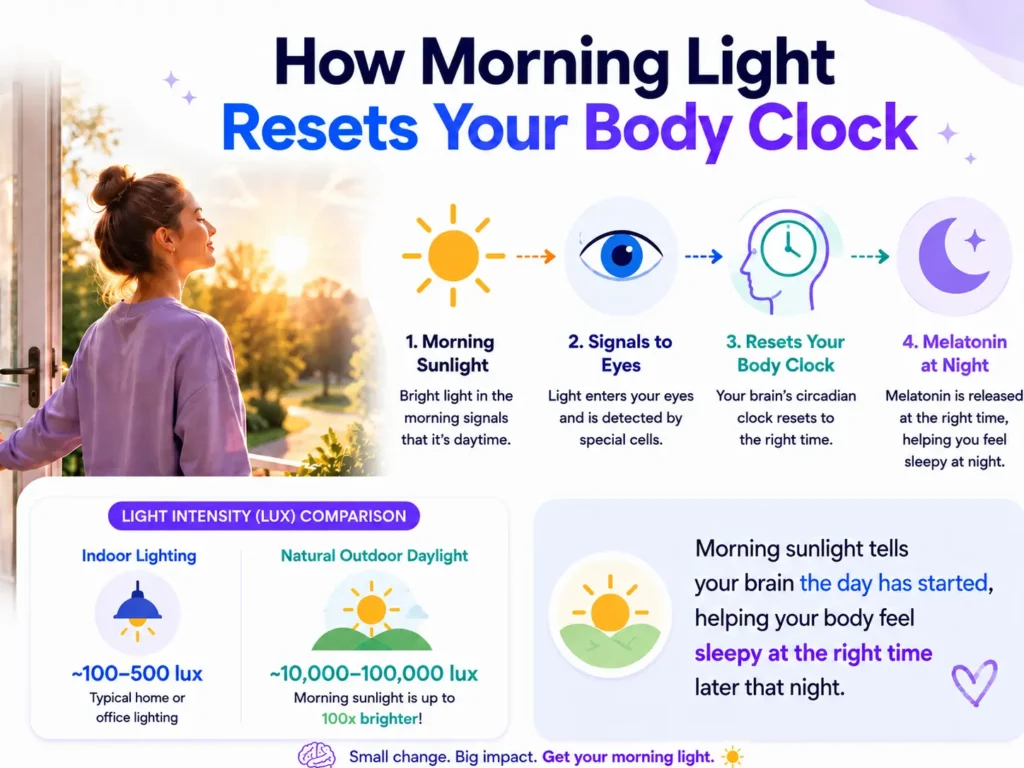
This is especially important if you have ADHD and suspect your rhythm runs late.
If your morning starts in darkness or dim indoor light, your brain may not receive a strong “daytime has started” signal. Then, if your evening is filled with bright screens and overhead lights, your brain gets a confusing message: low light in the morning, bright light at night. For a delayed ADHD sleep rhythm, that can make the whole system drift later.
The point is not to become obsessive. The point is to give your brain a clear morning anchor.
Caffeine is complicated for ADHD because many of us use it as a form of self-medication.
That morning coffee might not just feel enjoyable. It might feel like the thing that turns your brain on. So when someone says, “Just quit caffeine,” the advice can feel completely disconnected from reality.
Caffeine works mainly by blocking adenosine receptors. Adenosine is one of the chemicals that builds up the longer you are awake and contributes to sleep pressure. When caffeine blocks that signal, you feel more alert, but the sleep pressure does not magically disappear. It is being masked.
Andrew Huberman recommends experimenting with delaying caffeine 90–120 minutes after waking to support natural morning alertness and reduce the afternoon crash. I think this is useful for many ADHDers, but it is important to be honest: the exact 90-minute rule is more of a practical protocol than a universally proven law.
The stronger evidence is that caffeine later in the day can disrupt sleep, and studies have found that caffeine even six hours before bedtime can significantly reduce sleep quality. (Drake et al., 2013)
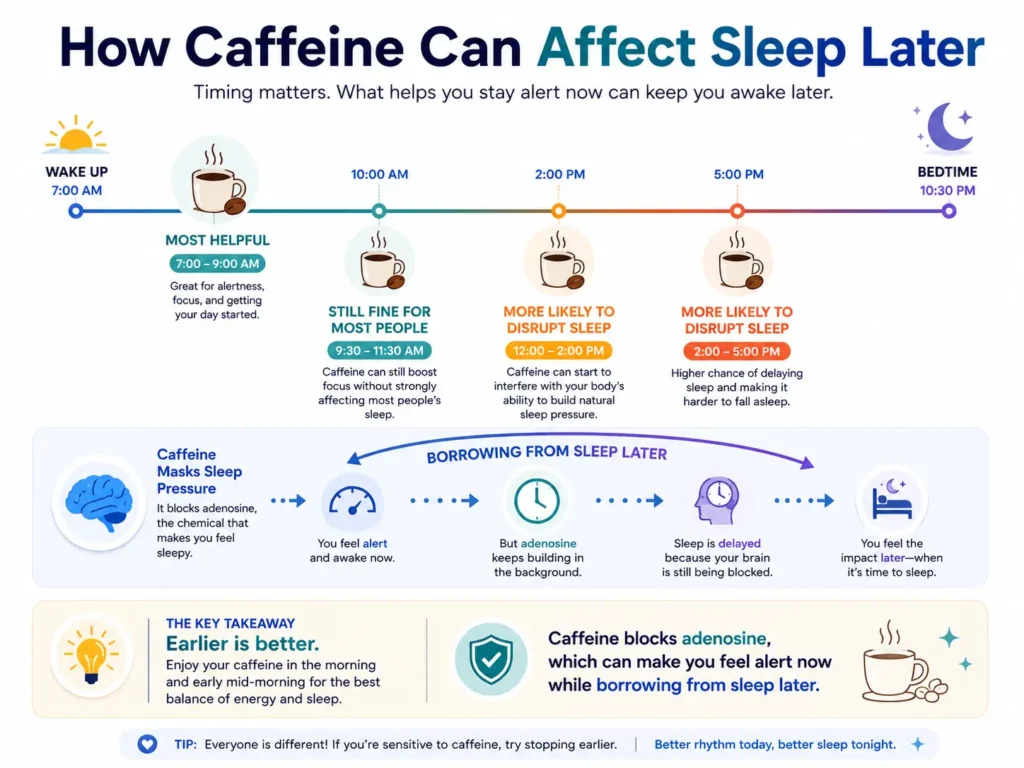
So instead of treating caffeine rules like morality, treat them like an experiment.
If waiting 90 minutes makes you miserable, start smaller. Wait 20 minutes. Then 40. ADHD brains do better with experiments than with rules that feel impossible by Tuesday.
Sometimes your sleep schedule does not need a tiny adjustment. It needs a reset.
Maybe you have been going to bed at 2 a.m. for weeks. Maybe travel, stress, work, gaming or a hyperfocus spiral pushed your rhythm later and later. This is where a short, structured reset can help.
I would treat the popular “3-day reset” idea as a practical circadian experiment, not a medical cure. The basic idea is to give your brain the same strong timing signals for three days in a row: consistent wake time, bright morning light, movement, delayed caffeine, limited naps, earlier food timing and dimmer evenings.
Choose a wake time you can realistically repeat for three days. Do not make it heroic. If you have been waking at 10:30, do not suddenly choose 5:30 unless life absolutely requires it.
Within the first hour of waking, get outside for light. Add gentle movement if you can: a walk, mobility, bodyweight squats, stretching or anything that tells your nervous system the day has started. Delay caffeine if possible, and avoid napping unless safety or health requires it.
That night, your only job is to make the evening less stimulating than usual. Dim lights, reduce screens, lower noise, prepare tomorrow and create a boring runway toward bed.
📖 Go deeperNot sure what kind of morning movement to choose? Read the complete guide to exercise and ADHD.
The second day matters because your brain learns timing through repetition. Wake at the same time again, get light again, move again and keep caffeine earlier in the day.
This is often the day ADHD brains rebel because novelty has worn off. That does not mean the reset is failing. It means you are asking your brain to follow a rhythm before that rhythm feels natural.
Keep it simple. Morning light. Same wake time. No late caffeine. Dim evening. Repeat.
By day three, many people notice they feel a little sleepier earlier, or at least less chaotic around bedtime. Not always, but often enough to make the experiment worth trying.
The mistake is treating day three like the finish line. It is better to see it as proof of concept. Your sleep rhythm responds to cues. If three days of stronger cues made even a small difference, imagine what two weeks of gentle consistency could do.
For ADHD, the reset is not really about becoming a morning person.
A wind-down routine should not be complicated. If it requires a twelve-step ritual, essential oils, journaling for forty minutes, stretching, breathwork, herbal tea, skincare, meditation and perfect lighting, most ADHDers will abandon it by Thursday.
The best ADHD wind-down routine is boring enough to signal sleep, but simple enough to repeat.
Think of your evening as a landing strip. A plane does not drop out of the sky and call it a landing. It descends gradually. Your brain needs the same thing. If your evening is full of bright screens, emotional conversations, work tabs, intense exercise, online shopping and fast dopamine, bedtime becomes an abrupt crash from stimulation to stillness.
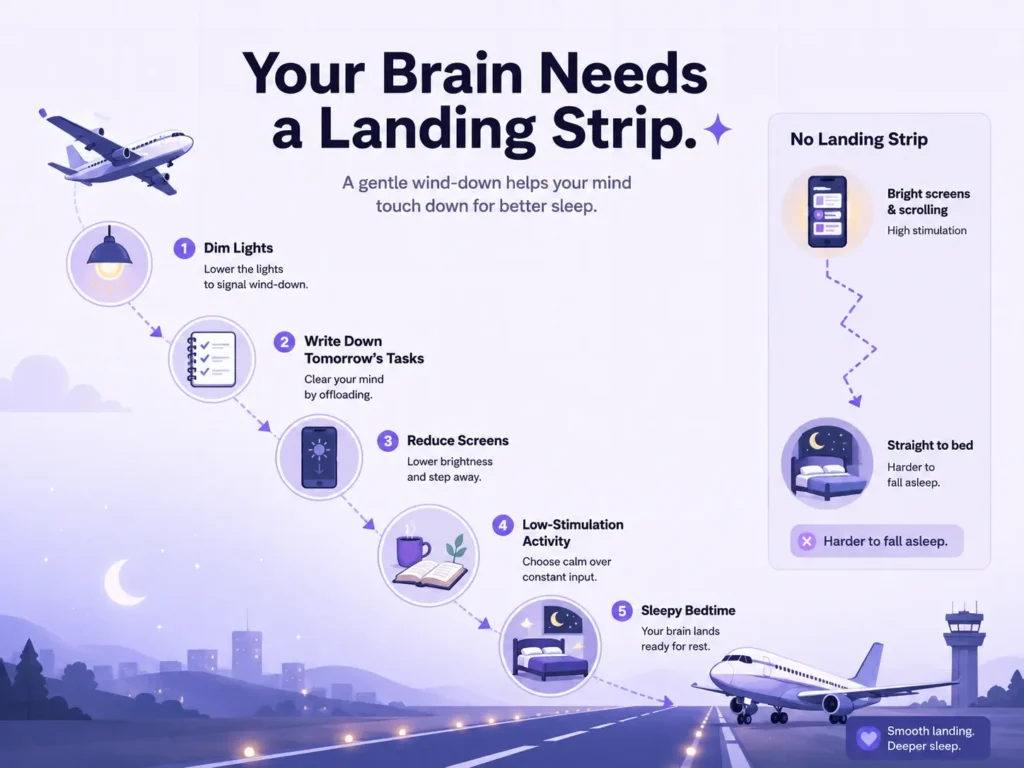
A better wind-down routine gradually removes the inputs that keep your brain chasing the next interesting thing.
Try building your routine around four cues:
Dim overhead lights 60–90 minutes before bed if possible. Use lamps instead of bright ceiling lights. Reduce screen brightness, use night mode and consider moving your phone out of reach. Evening light exposure can delay circadian timing and affect sleep, and the CDC recommends turning off electronic devices at least 30 minutes before bedtime as part of basic sleep hygiene.
ADHD brains hate unfinished loops. If you lie down with seventeen floating tasks in your head, your brain may keep trying to solve them in bed.
Do a simple “brain shutdown”:
Write it somewhere external. Your brain is not supposed to be your storage device.
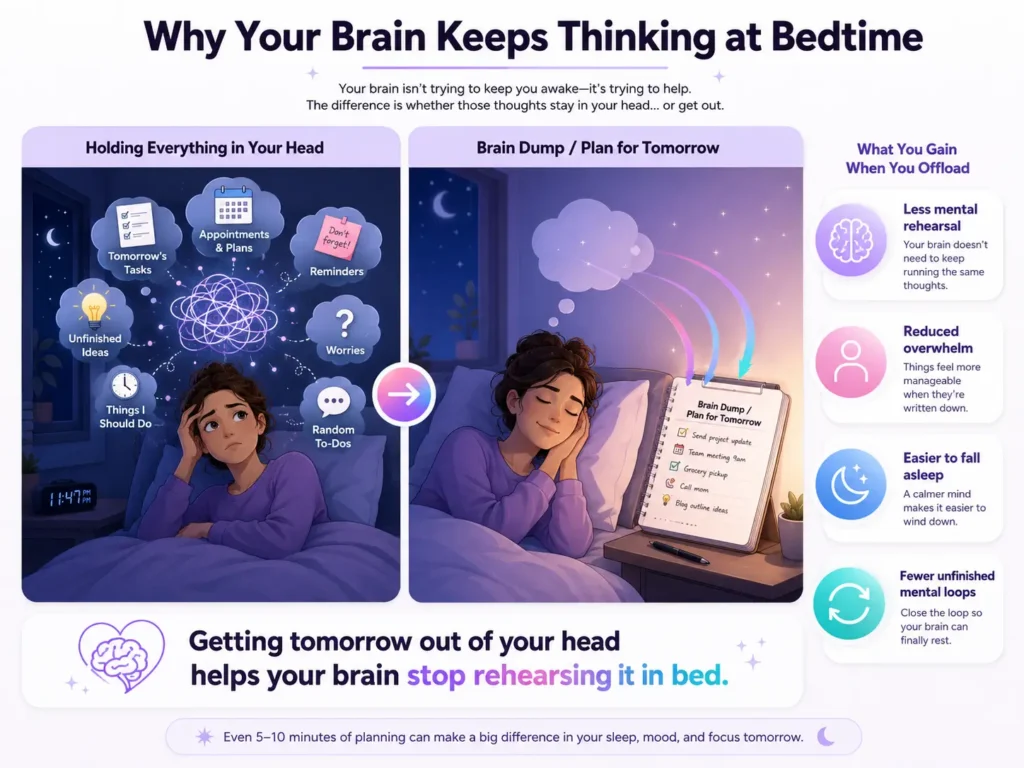
This is exactly why I care so much about external systems inside ADHD Bright. The moment your brain trusts that tomorrow’s plan is captured somewhere, it does not have to keep rehearsing it at midnight.
🧭 Compare optionsChoosing a system to capture tomorrow’s plan? See the side-by-side comparison of the best ADHD planners.
Choose a low-stimulation activity that is not exciting enough to steal two hours of your life. This might be reading something familiar, stretching, folding laundry, listening to calm audio, doing a simple skincare routine, preparing clothes or making tea.
The goal is not entertainment. The goal is a gentle decline in novelty.
Do the same few things in the same order most nights. ADHD brains often resist routine because routine sounds restrictive, but a good evening routine is not there to control you. It is there to reduce the number of decisions between “I should go to bed” and actually getting into bed.
There is a cruel little trap many ADHDers fall into: you go to bed, cannot sleep, get frustrated, stay in bed trying harder, and accidentally teach your brain that bed is a place for frustration, thinking and clock-watching.
This is where CBT-I principles become useful.
CBT-I stands for Cognitive Behavioral Therapy for Insomnia. It is not just “sleep hygiene.” It is a structured, evidence-based treatment that works with the behaviours and thought patterns that keep insomnia going. The American College of Physicians recommends CBT-I as the initial treatment for chronic insomnia in adults.
One CBT-I principle is called stimulus control. The basic idea is that your bed should become strongly associated with sleep, not with scrolling, worrying, working or trying to force unconsciousness. AASM-related CBT-I guidance commonly includes going to bed only when sleepy, getting out of bed if you cannot sleep and using the bed mainly for sleep and sex.
For ADHD, this can feel annoying at first because leaving the bed sounds like “waking yourself up more.” But the deeper logic makes sense: if your brain is clearly not sleeping, staying in bed for an hour of frustration does not train sleep. It trains frustration.
If you are awake for roughly 20–30 minutes and becoming irritated, get out of bed and do something dim, quiet and boring. No phone. No work. No bright lights. Return when sleepy.
You are not punishing yourself. You are protecting the association between bed and sleep.
This part matters because not every sleep problem can be fixed with routines.
It is worth speaking to a doctor or sleep specialist if you:
Adults with ADHD may have high rates of delayed sleep phase, insomnia and restless legs or periodic limb movement symptoms, and these issues can worsen mood, attention and daily functioning.
This is especially important for parents supporting kids or teens with ADHD. If a child is snoring, struggling to wake, falling asleep in class, having restless sleep or becoming dramatically more dysregulated with poor sleep, do not assume it is “just ADHD.” Sleep-disordered breathing, restless legs, anxiety, medication timing and delayed circadian rhythm can all show up as worse behaviour, worse attention and worse emotional regulation.
Melatonin is often talked about casually, but it is worth understanding what it actually does.
Melatonin is not a sleeping pill in the simple sense. It is more like a darkness signal. It helps tell your body that biological night is approaching. That is why timing matters so much, especially for delayed sleep phase. Taking it randomly at bedtime is not the same as using it strategically to shift circadian rhythm.
Research in adults with ADHD and delayed sleep phase has found that chronotherapy with melatonin advanced dim-light melatonin onset by about 1.5 hours and reduced ADHD symptoms by 14% in prior work; combined melatonin and bright light therapy advanced circadian timing even more (about 2 hours), but didn’t improve ADHD symptoms further. (van Andel et al., 2022)
That does not mean everyone with ADHD should take melatonin. Dose, timing, age, medication interactions and health history matter. For children and teens especially, this is something to discuss with a clinician.
If your sleep is a mess, please do not try to fix everything at once. That is how ADHD self-improvement turns into a three-day identity crisis followed by complete abandonment.
Start with the highest-leverage anchors.
A consistent wake time is often more powerful than a forced bedtime because it anchors the circadian rhythm from the morning. If you try to go to bed early without changing the morning signal, you may just lie there awake feeling broken.
Choose a wake time you can repeat most days. It does not need to be perfect. It needs to be consistent enough that your brain starts receiving a predictable “day begins now” signal.
Morning light is the circadian equivalent of pressing “start” on the day. Without it, especially during winter or indoor-heavy days, your brain may drift later.
Pair it with something easy: coffee later, a podcast walk, feeding the dog, opening the balcony door, walking around the block, standing outside while checking your calendar.
You do not have to quit coffee. Just stop letting coffee quietly sabotage your night. Experiment with delaying your first caffeine and setting a hard cut-off early enough that it is not still affecting your sleep.
For many people, this means no caffeine after lunch. For sensitive people, even earlier.
Do not expect your brain to go from TikTok, work, YouTube or stress straight into sleep. Build a bridge. Dim lights, reduce novelty, externalise tomorrow’s tasks, then do something low-stimulation.
The routine should be almost embarrassingly simple.
This is the one nobody wants to hear, but it matters. Your phone is not just a screen. It is a portable novelty machine with infinite reward. For an ADHD brain, keeping it in bed is like trying to sleep next to a slot machine that also contains your friends, your work, your memories, your shopping, your entertainment and every question you have ever wanted answered.
Charging it across the room or outside the bedroom is not about discipline.
It is about not putting the most stimulating object you own within arm’s reach at the exact moment your brain is supposed to downshift.
For one week, track:
You are not tracking to judge yourself. You are collecting evidence. ADHD brains often change behaviour more easily when the cause and effect becomes visible.
You might notice that caffeine after 2 p.m. ruins your sleep. Or that morning light helps more than you expected. Or that Sunday night insomnia is actually Monday anxiety. Once you see the pattern, you have a lever.
📖 Go deeperWant systems that make tracking and follow-through easier? Read my guide to ADHD productivity strategies that work without willpower.
If you want a practical place to start, try this for seven days.
At the end of seven days, ask one question:
Which change made tomorrow’s ADHD easier?
That is the one to keep.
📖 Go deeperAfternoon crashes and late snacking can be part of the sleep story too. Read the complete guide to ADHD and nutrition.
For years, many of us treated sleep as something outside ADHD management.
Focus was ADHD. Procrastination was ADHD. Emotional dysregulation was ADHD. Forgetting things was ADHD.
Sleep was just sleep.
But once you understand what poor sleep does to the prefrontal cortex, that separation stops making sense. Sleep is not separate from ADHD. Sleep changes how much access you have to the very brain functions ADHD already makes harder to use.
That does not mean sleep will cure ADHD. It will not.
But it can change the intensity of your symptoms. It can make your emotional reactions less explosive, your working memory less fragile, your mornings less painful and your follow-through less dependent on heroic effort.
You do not need to fix your entire life tonight.
Start with one signal.
Now that you understand why it matters: