Dr. Daniel Amen, a psychiatrist who has spent decades imaging brains rather than just interviewing the people attached to them, has looked at tens of thousands of SPECT scans, a type of brain imaging that shows blood flow and activity, rather than just structure. When someone with what he calls “classic” ADHD tries to concentrate, their prefrontal cortex doesn’t light up the way you’d expect. It goes quiet. Cooler. Less active, at exactly the moment it should be working hardest.
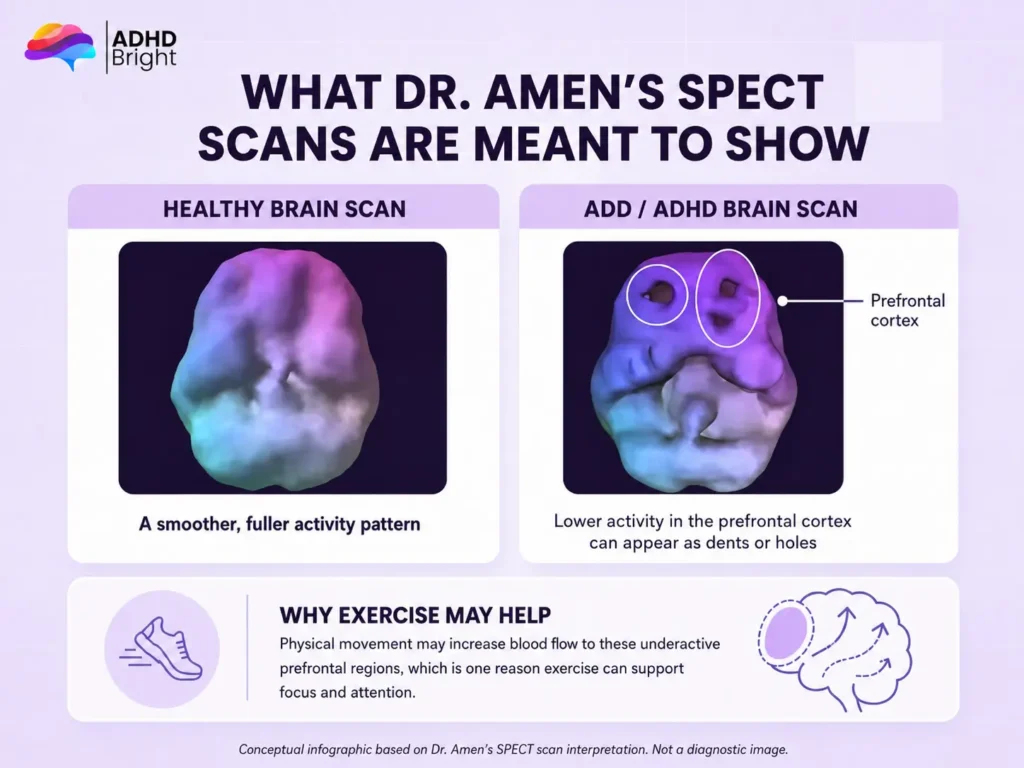
Sit with that for a second, because it reframes everything that comes next. Your brain isn’t refusing to focus out of laziness or a lack of trying. On a very literal, measurable level, the part of your brain responsible for focus is running on reduced power at the exact moment you’re demanding the most from it. You’ve probably felt this a thousand times without ever having the image to go with it. That sensation of genuinely wanting to concentrate, trying to force it, and just… not being able to summon the horsepower. That’s not you being weak-willed. That’s a “cold” prefrontal cortex, caught on a scan.
Here’s the part that actually matters for this article. One of the few things Amen has found that reliably increases blood flow and activity in exactly that region is movement. Not a supplement, not a hack, not a mindset. Physical exercise. And once you understand why that’s true at a chemical level, “you should exercise more” stops sounding like something someone says to make you feel guilty, and starts sounding like something worth doing because you finally understand the mechanism behind it.
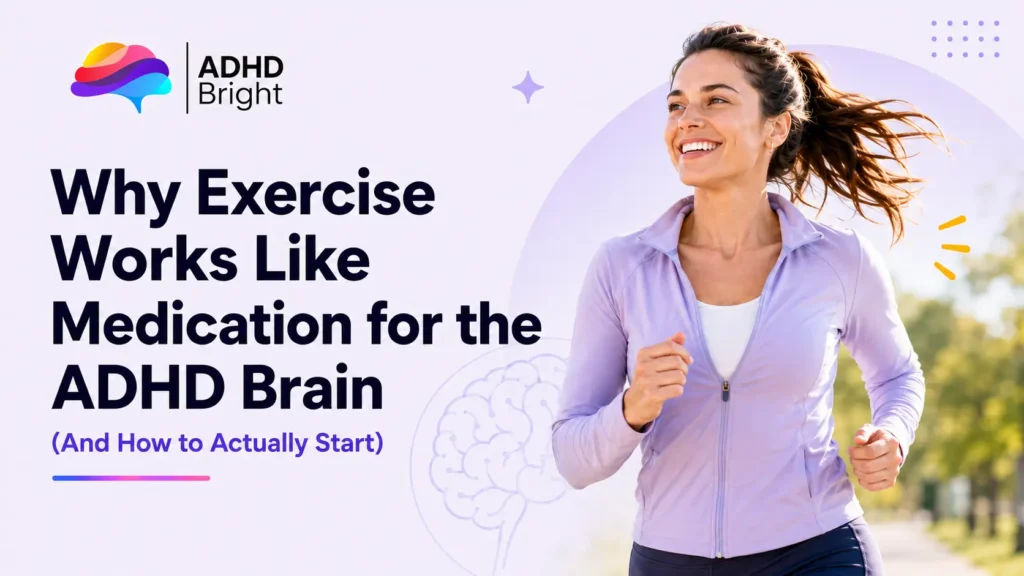
If you’ve read our guide on managing ADHD without medication, you already know I like to talk about your prefrontal cortex as a battery. Exercise isn’t a separate wellness habit sitting next to your ADHD management. It’s one of the most direct ways to charge that exact battery — and it works in a way that’s remarkably similar to the medication a lot of us already take.
Exercise Is a Chemical Cousin of Your Medication
Here’s something that genuinely changed how I think about a morning run, and I think it’ll do the same for you.
Most stimulant medications for ADHD work by increasing the availability of two neurotransmitters in your brain: dopamine and norepinephrine. These are the chemicals responsible for motivation, alertness, reward and sustained attention. ADHD brains regulate both of these less efficiently than neurotypical brains, which is the actual biological reason focus feels like such an uphill climb some days, no matter how much you want it.
Exercise increases the availability of both of these same neurotransmitters. Not metaphorically — mechanistically. When you move your body, particularly with any real intensity, your brain releases dopamine and norepinephrine in a way that’s genuinely comparable, in mechanism if not in magnitude, to what your medication is doing. John Ratey, the Harvard psychiatrist who spent years compiling the research on exercise and the brain in his book Spark, has described ADHD as a disorder of poorly regulated attention systems that are short on exactly these two chemicals — and has pointed to exercise as one of the few reliable, drug-free ways to top them back up.
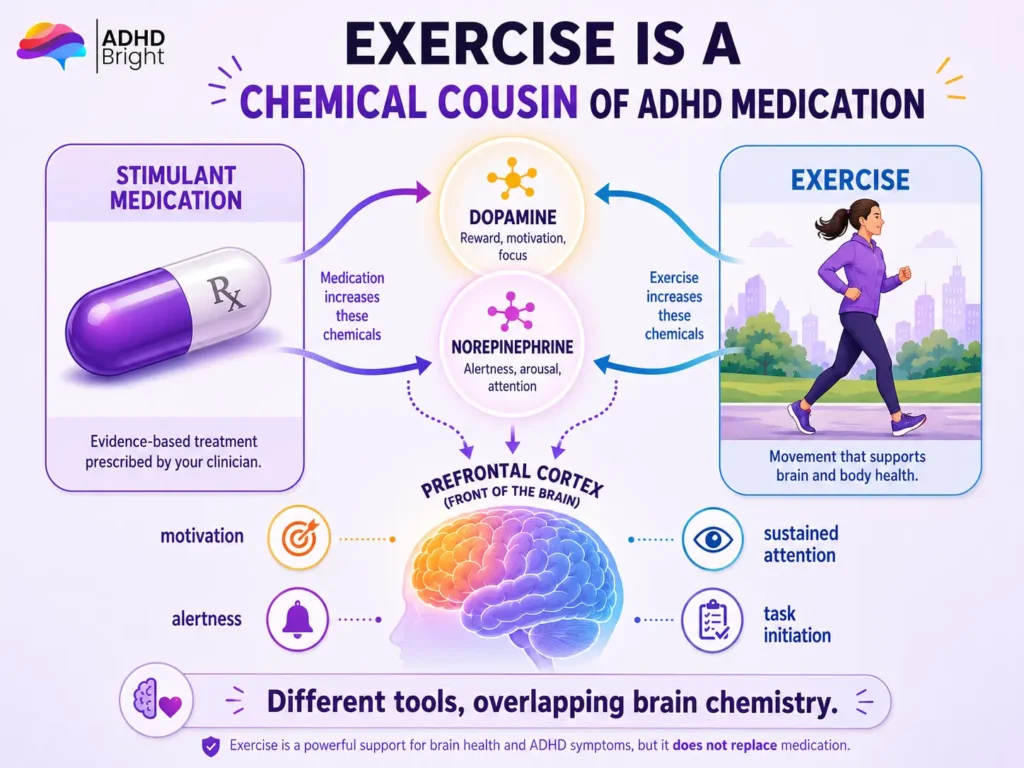
This is why so many people with ADHD describe a genuinely different quality of thought after a workout. Not just “less restless.” Actually clearer. More able to start the task they’ve been avoiding all morning. That’s not a placebo effect or just feeling good about having exercised. That’s dopamine and norepinephrine, freshly released, doing the job they were always supposed to do.
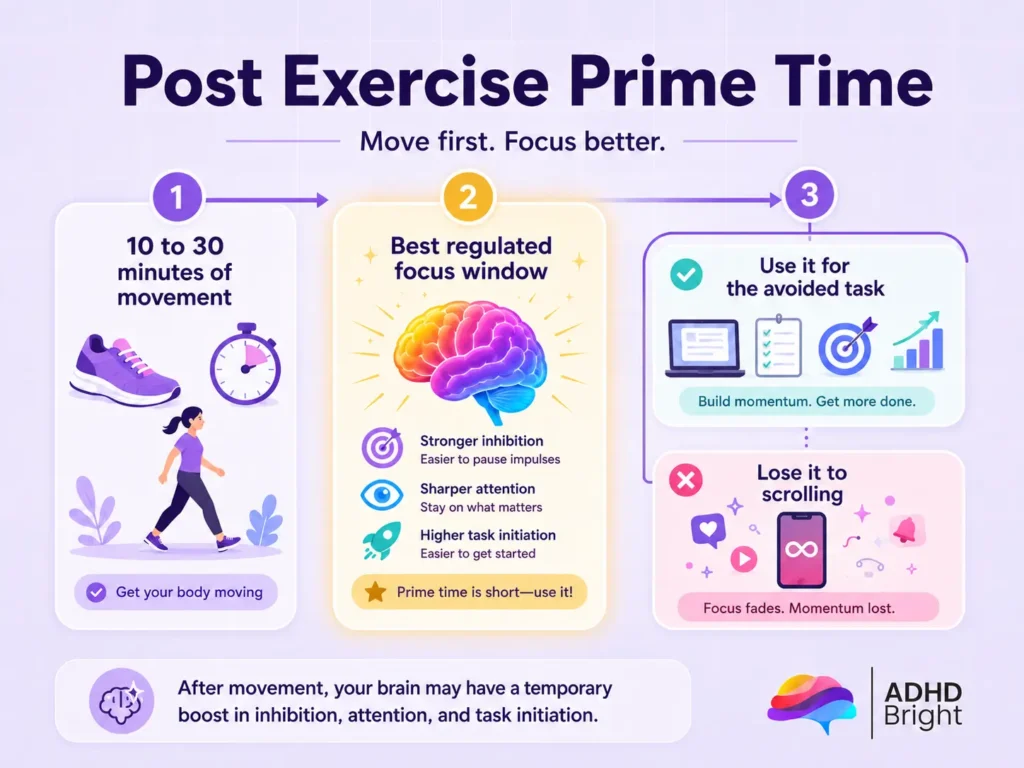
A 2026 systematic review looking specifically at adults with ADHD found that a single session of exercise produced a moderate improvement in inhibitory control. It’s the ability to stop yourself doing the impulsive thing and a smaller but still statistically real improvement in inattention. One session. Not months of training, not a lifestyle overhaul. A single bout of movement, and a measurable shift in exactly the two areas that make daily life with ADHD hardest.
This is why the old advice to “exercise in the morning before anything demanding” isn’t just a nice suggestion. If a single session genuinely improves inhibitory control and attention in the hours that follow, then the window right after you exercise is quite literally one of the best-regulated windows your brain will have all day. Wasting it by scrolling instead of tackling the task you’ve been avoiding is like warming up a car and then leaving it parked in the driveway.
Your Brain Is Growing New Connections While You Move
There’s a second mechanism worth understanding, because it explains why exercise doesn’t just help you focus today. It changes the brain you’ll have tomorrow.
Exercise increases a protein called brain-derived neurotrophic factor, or BDNF. Researchers sometimes describe it as fertiliser for the brain, because that’s essentially what it does: it supports the growth of new neural connections and helps existing ones survive and function better. This matters enormously for ADHD, because the difficulty isn’t just about having too little dopamine in the moment. It’s about the underlying networks that regulate attention, impulse control and emotional response being less efficiently wired to begin with.
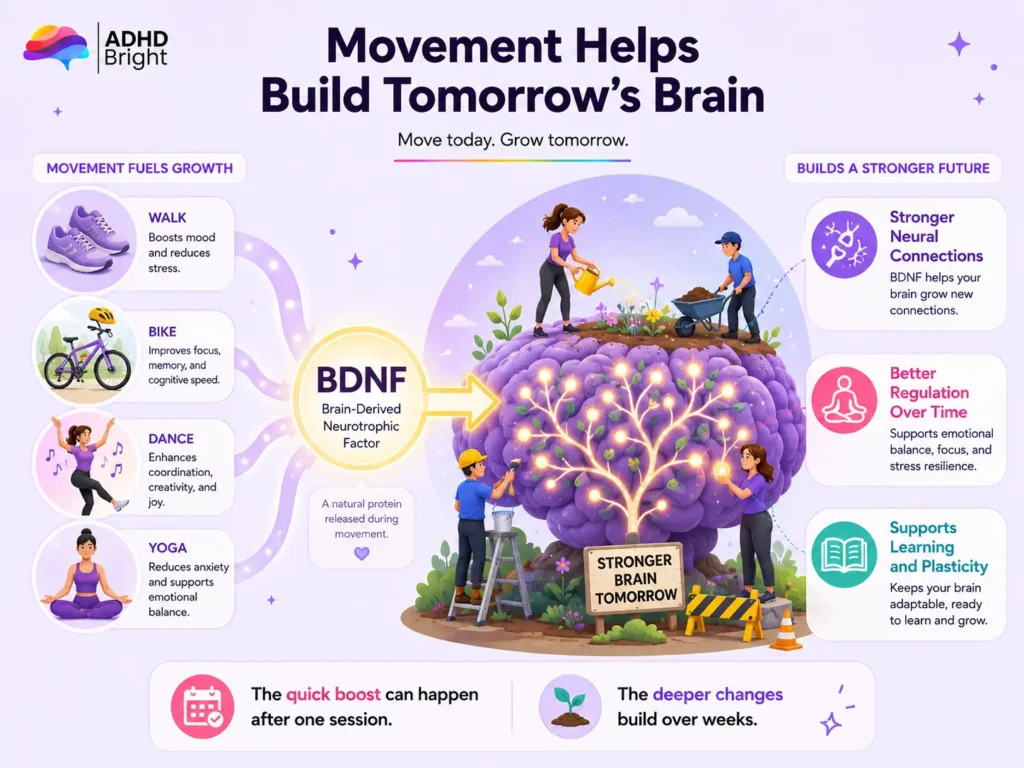
The evidence on BDNF is genuinely promising, though I want to be honest with you rather than oversell it: results vary depending on exercise intensity, duration and the population studied, and not every trial finds a significant increase. What the more consistent research does show is that vigorous aerobic activity, sustained over several weeks rather than a single session, tends to produce the clearest BDNF gains. In other words, this particular benefit isn’t something you get from one great workout. It’s something you build, the same way you’d build any other kind of physical strength, gradually, and mostly invisibly, until one day the difference is obvious in hindsight.
Once you understand this, exercise stops looking like something you do to burn off restlessness. It becomes something closer to construction work, quietly building a brain that’s easier to regulate next month than it is today.
The Coordination Connection Nobody Talks About
Here’s a detail that surprised me the first time I came across it, and it explains something I’d noticed about my own workouts without ever understanding why.
Not all exercise seems to affect the ADHD brain equally. Steady, repetitive cardio like the treadmill, the stationary bike — genuinely helps, largely through the dopamine and norepinephrine mechanism above. But a growing body of research points to something extra going on with exercise that requires coordination, timing, and quick decision-making: martial arts, dance, table tennis, rock climbing, racquet sports.
The reason traces back to a part of the brain most people associate purely with balance and movement: the cerebellum. For a long time, nobody thought the cerebellum had much to do with attention at all. That’s changed. Researchers have found that people with ADHD frequently show differences in cerebellar structure and connectivity, and — this is the interesting part — the cerebellum is directly wired into the prefrontal cortex, the same region we started this article talking about. It doesn’t just coordinate your footwork. It appears to help coordinate your thoughts, acting almost like a metronome that keeps attention and processing running on time rather than arriving late or jumbled.
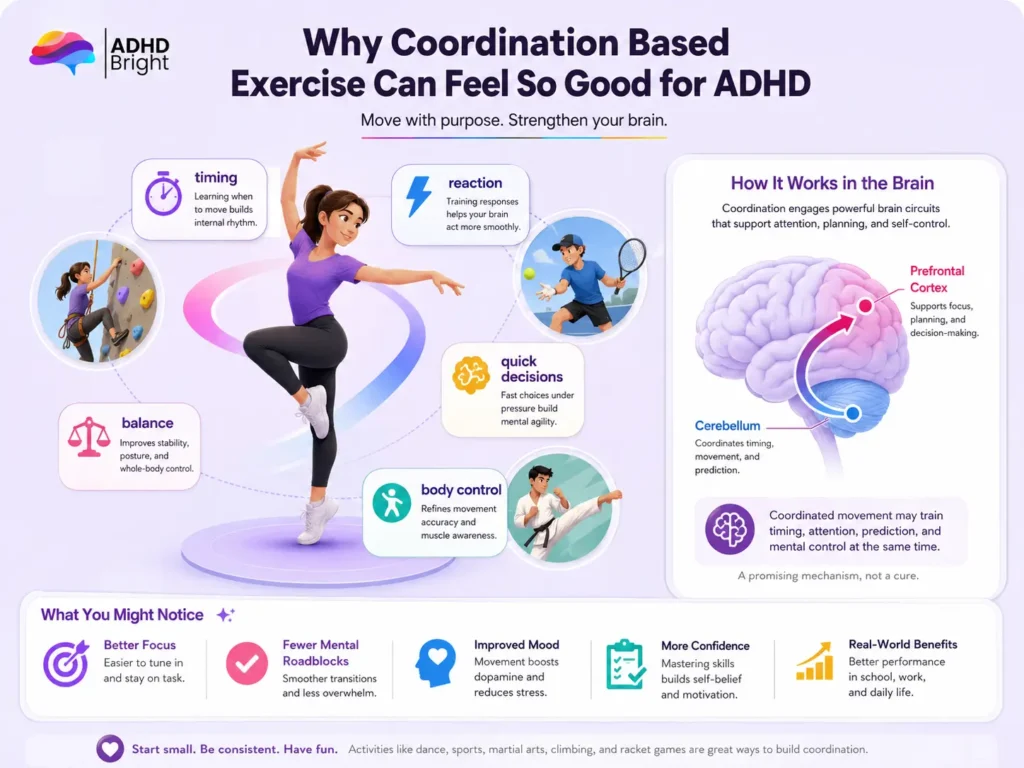
This is very likely why Amen specifically points people toward activities like martial arts and dance rather than just “get more cardio.” When you’re sparring, or following choreography, or returning a serve, you’re not just moving — you’re constantly predicting, timing, adjusting and correcting in real time. Every one of those micro-corrections is a rep for the exact cerebellum-to-prefrontal-cortex pathway that ADHD brains seem to rely on more heavily than most. I want to be honest that this research area is newer and less settled than the dopamine mechanism above, but it offers a genuinely compelling explanation for something a lot of us have felt anecdotally for years: that a dance class or a boxing session leaves your head feeling clearer in a way that thirty minutes on a treadmill sometimes doesn’t.
What this looks like in practice
- Treat post-exercise time as prime time, not free time. If a workout genuinely improves your inhibitory control and attention for a window afterward, use that window for the task you’ve been avoiding, not for the phone.
- Don’t assume all exercise is interchangeable. If steady cardio feels like a chore you can never sustain, a coordination-heavy option — martial arts, dance, climbing, tennis — may genuinely engage your brain differently, not just your body.
- Think in weeks, not workouts, for the deeper changes. The mood and focus boost from a single session is real and immediate. The structural changes — BDNF, new neural efficiency — build gradually, so don’t judge the habit by day three.
Why “Just Start Exercising” Was Never Realistic Advice
Here’s where most articles about exercise and ADHD fall apart, and I want to address it directly instead of pretending it isn’t the actual problem.
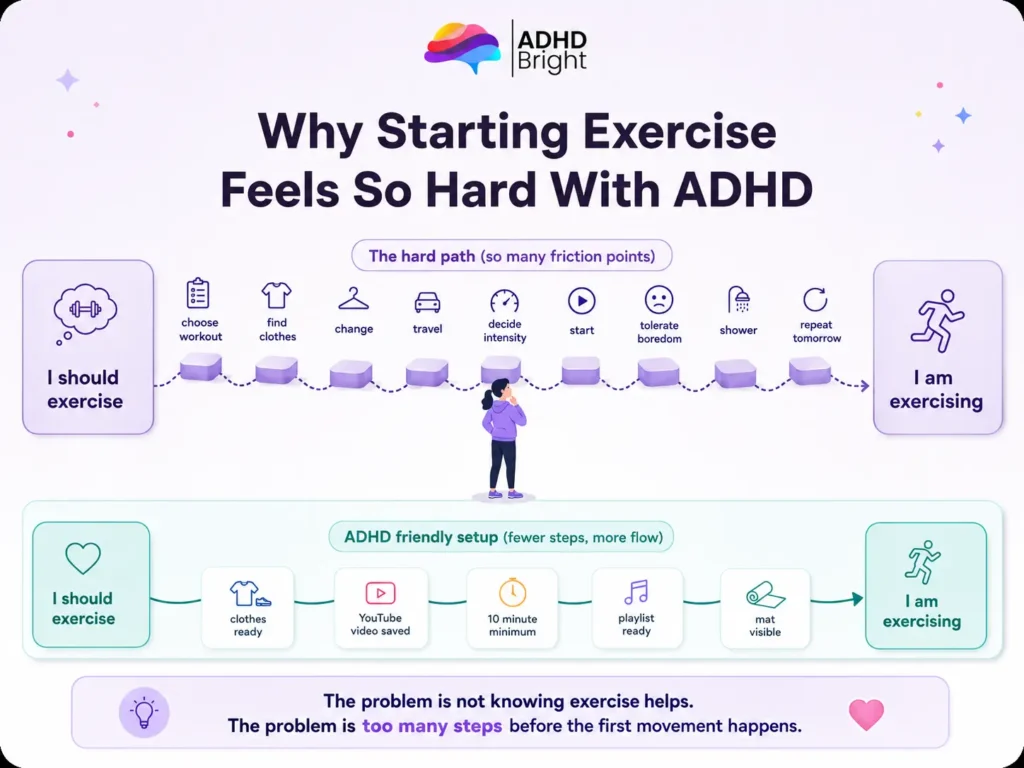
Understanding the neuroscience doesn’t automatically make it easier to put your shoes on. ADHD isn’t a knowledge problem. You already knew exercise was good for you before you read a single word of this article. The real barrier is almost always executive function: the number of small decisions and initiations required just to begin a workout is often the exact thing an ADHD brain struggles with most, regardless of how much you want the outcome.
This is where I think a lot of well-meaning advice actually works against people with ADHD. “Just find your motivation” assumes motivation is the missing ingredient. It usually isn’t. What’s actually missing is enough of the activation energy required to get from “I should exercise” to “I am currently exercising,” and for an ADHD brain, that gap is often the entire battle.
So instead of trying to manufacture more willpower, it’s far more effective to reduce the number of decisions and friction points standing between you and starting. This is where something that sounds almost embarrassingly trivial turns out to matter more than it should: what you’re going to wear.
Buying workout clothes you genuinely like — not just functional, but ones that make you feel like a specific version of yourself when you put them on — isn’t vanity, and it isn’t wasted money. It’s doing exactly what James Clear describes as making a habit more attractive, combined with a well-documented psychological effect where the identity we visually associate with an activity actually shapes whether we do it. If putting on a certain outfit makes you feel, even briefly, like someone who exercises, you’ve just removed one of the biggest hidden barriers between deciding to work out and actually doing it — the internal negotiation of “do I really want to do this right now.” Lay the clothes out the night before, and you’ve removed a second one. None of this is really about the clothes. It’s about engineering fewer decision points for a brain that treats every extra decision as a potential exit ramp.
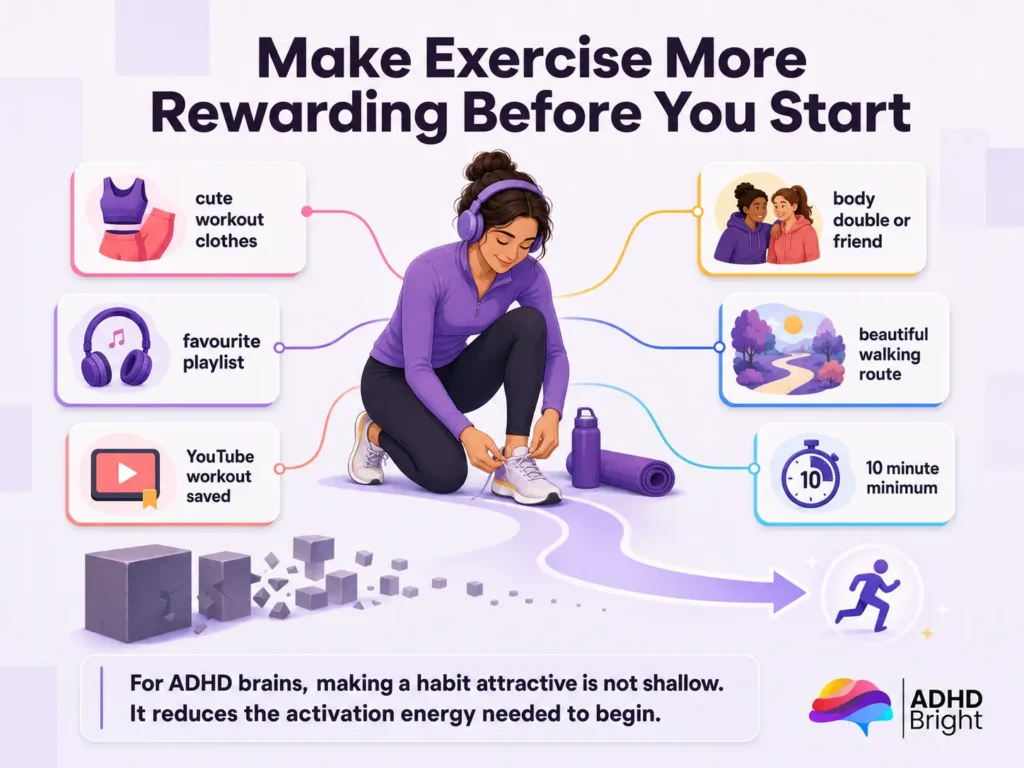
The same logic applies everywhere else in how you set up exercise. Pick something you find genuinely stimulating rather than something you think you’re supposed to do — if the gym bores you within ten minutes, a class with music, a sport with an opponent, or a trail with scenery will hold your attention far better, because novelty and stimulation are exactly what an under-stimulated dopamine system responds to. Exercising with another person, even just a friend who happens to be doing their own workout beside you, taps into something ADHD coaches call body doubling — simply having someone else present makes it substantially easier to start and stick with a task, and a workout is no exception. And pairing exercise with something you already look forward to, like a specific podcast or playlist you only allow yourself during a workout, borrows a technique researchers call temptation bundling, using an existing reward to pull you toward a harder one.
What this looks like in practice
- Buy workout clothes you actually like wearing, and lay them out the night before so there’s one less decision standing between you and starting.
- Choose stimulation over discipline. A boring workout you’re “supposed” to enjoy will lose to your dopamine system every time. A workout with novelty, competition, music or scenery works with your brain instead of against it.
- Exercise near another person when you can. Body doubling — someone else simply being present — measurably reduces the activation energy needed to start.
- Bundle it with something you already want. Save a favourite podcast, playlist or audiobook exclusively for workout time, so part of you starts looking forward to it rather than dreading it.
- Start smaller than feels meaningful. Ten minutes of movement that actually happens will always outperform an hour-long plan that never gets off the ground. Consistency, not intensity, is what builds the BDNF and dopamine-regulation benefits over time.
The Reframe Worth Keeping
None of this is really about becoming an athlete, and it was never about punishing yourself into shape. What I want you to take from this is much simpler: your brain, on a scan, looks measurably different when it’s under-stimulated and struggling to focus than it does after movement. That’s not a metaphor. That’s blood flow, dopamine, norepinephrine and BDNF, all doing something observable.
Once you understand that exercise is chemically closer to your medication than to a chore on a wellness checklist, skipping it stops making sense in quite the same way. You’re not failing at discipline every time you don’t work out. You’re simply leaving one of the more direct levers on your own brain chemistry untouched — and now that you know where the lever is, and roughly how it works, reaching for it gets a little easier every time.
This article is a companion to our guide on managing ADHD without medication — exercise is one more lever in the same system, alongside sleep and nutrition, all working toward the same goal: giving your brain what it actually needs to regulate itself.