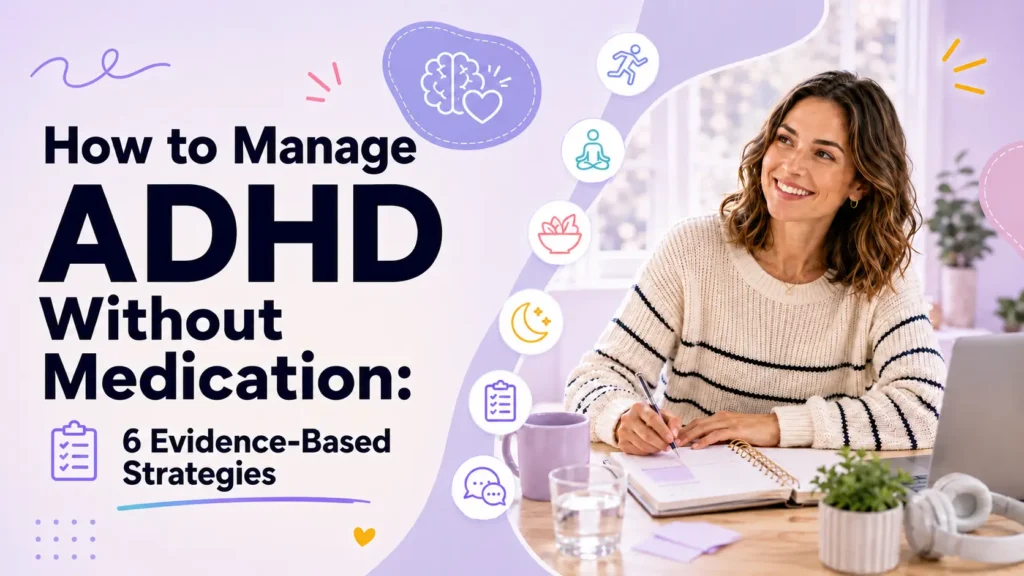
TL:DR: Managing ADHD without medication isn’t about trying harder.
Research consistently shows the biggest improvements come from supporting the brain systems ADHD affects most.
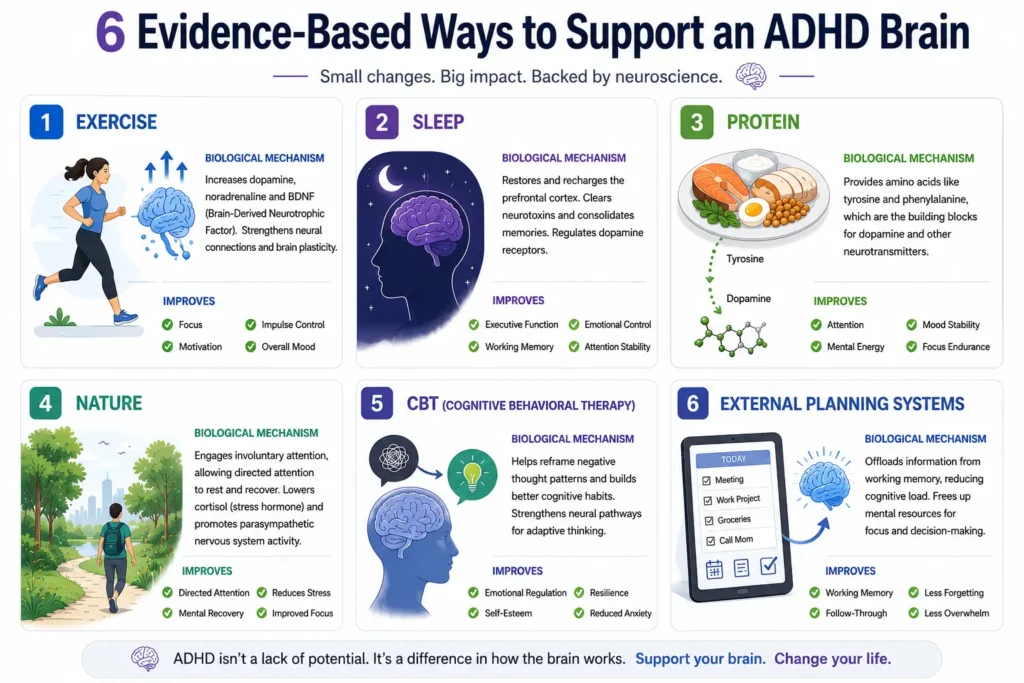
Focus on these six areas:
- Exercise increases dopamine and noradrenaline while strengthening executive function.
- Sleep restores the prefrontal cortex that ADHD already struggles to use efficiently.
- Protein provides the raw materials needed to produce neurotransmitters like dopamine.
- Time in nature helps restore directed attention and reduce mental fatigue.
- ADHD-adapted CBT teaches practical systems rather than relying on willpower.
- External planning systems reduce the burden on working memory.
The rest of this guide explains why each of these works so that they stop feeling like chores and start making biological sense.
There’s a specific kind of exhaustion that comes from constantly being told things you already know.
Get more sleep. Exercise more. Eat better. Try meditation.
If you have ADHD, you’ve probably heard all of it, usually from well-meaning people who have no idea why none of it sticks. And if you’ve ever tried following that advice through sheer willpower, you probably know how the story ends: a few good days, then life gets in the way, the routine falls apart, and you’re left wondering why something that seems so easy for everyone else feels impossible for you.
The problem isn’t that you don’t know what to do.
The problem is that almost nobody has explained why these things matter for an ADHD brain.
This article is different.
I’m not going to give you another list of habits and tell you to “just be more disciplined.” Most people with ADHD already know they should exercise more, eat more protein, get better sleep, and spend less time on their phones. Knowledge has never been the problem.
Instead, I’m going to explain why each of those things has such a profound effect on an ADHD brain. Because once you understand the mechanism, the conversation in your head begins to change. You’re no longer exercising because someone told you to. You’re exercising because you understand you’re making tomorrow’s ADHD easier to manage. You’re no longer prioritising sleep because it’s the “healthy” thing to do. You’re doing it because you realise that poor sleep temporarily weakens the very brain functions ADHD already makes more difficult.
Understanding doesn’t remove the effort. Building new habits is still hard, especially with ADHD. But understanding gives those habits meaning. And when something genuinely makes sense, it’s much easier to stay consistent than when it feels like another rule someone expects you to follow.
The Missing Piece Most ADHD Articles Never Explain
One of the biggest misconceptions about ADHD is that it’s simply a deficit of attention. Honestly, I think it’s one of the worst pieces of medical branding in history because it immediately sends people looking for the wrong solution. The problem isn’t that people with ADHD can’t pay attention. Most of us know exactly what it’s like to become so absorbed in something interesting that we completely lose track of time. The real challenge is regulating what captures our attention and whether we can redirect it when life demands something less exciting.
To understand why that happens, we need to talk about dopamine.
Most people think of dopamine as the brain’s “feel-good” chemical, but that’s a huge oversimplification. A much better way to think about it is as your brain’s “this is worth doing” chemical. Dopamine is constantly helping your brain decide what’s worth paying attention to, what deserves your effort, and whether a task is important enough to start in the first place. Without realising it, your brain is asking that question hundreds of times a day.
“Is this worth doing?”
When dopamine signalling is working well, your prefrontal cortex, the part of your brain responsible for planning, prioritising and following through, can answer that question fairly accurately. It recognises that paying your electricity bill is more important than watching another YouTube video, even if it’s far less enjoyable. It doesn’t mean you suddenly love doing boring tasks, but your brain can still generate enough motivation to get started because it understands that the future reward is worth the effort.
An ADHD brain doesn’t answer that question in quite the same way.
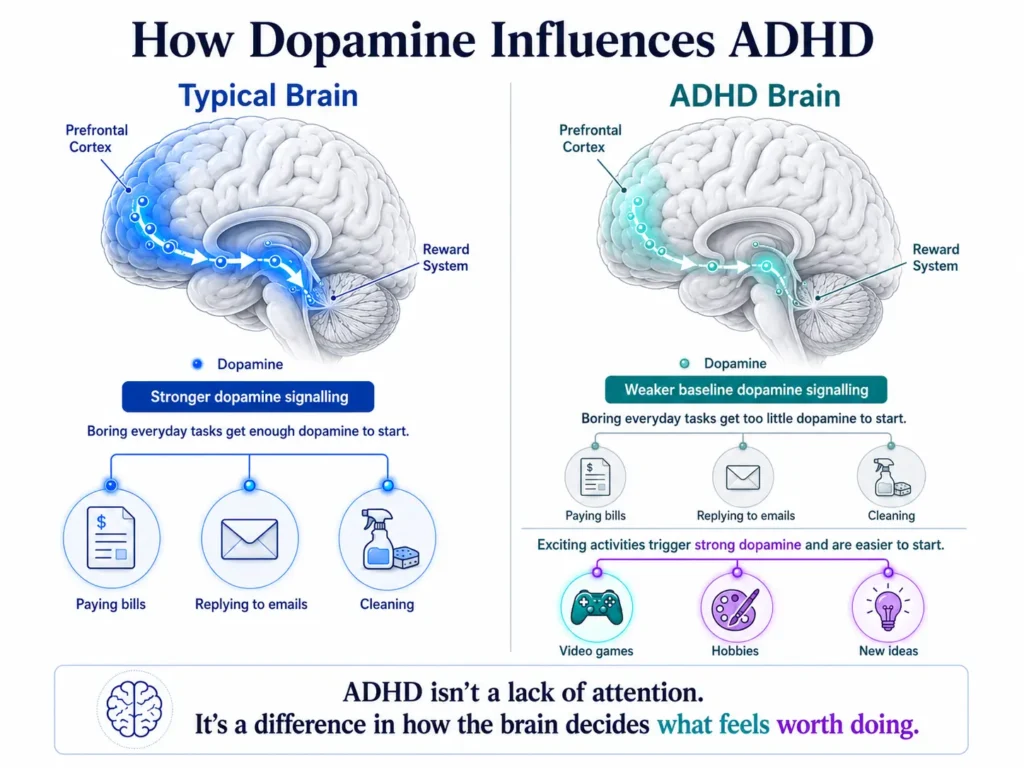
Research has consistently found differences in dopamine signaling within the brain’s reward circuits, particularly in the pathways connecting the prefrontal cortex with deeper brain structures involved in motivation and reward. You don’t need to remember the names of those brain regions because the practical consequence is far more important: tasks that don’t offer an immediate sense of reward often fail to generate a strong enough dopamine signal to compete for your attention.
Think about the last time you spent three days avoiding a task that would have taken five minutes to complete. Maybe it was replying to an email, booking a doctor’s appointment or finally doing your tax return. Meanwhile, you somehow found yourself spending two hours researching the perfect coffee machine, watching videos about a new hobby or reorganizing your desk because it suddenly felt incredibly important.
That isn’t because your brain randomly decides to work one moment and stop working the next.
Your brain isn’t being lazy when it refuses to start the tax return. It’s accurately reporting that the tax return isn’t generating enough of a reward signal to compete with everything else around you.
The fascinating thing is that the exact same brain can then hyperfocus for six hours on something novel, urgent or deeply interesting because that activity is producing a completely different chemical response.
Once I understood this, I stopped asking myself, “Why can’t I just make myself do it?” It was the wrong question.
A much better question is:
“How can I help my brain see this as worth doing?”
That shift in perspective changes almost everything, because it explains why willpower alone rarely works. Willpower assumes the problem is motivation. ADHD is much more often a problem of regulation. If your brain isn’t generating a strong enough reward signal to begin with, trying harder isn’t addressing the real issue.
It’s also the thread that connects everything else in this article. Every strategy you’re about to read works for one of two reasons. It either helps your brain regulate neurotransmitters like dopamine and noradrenaline more effectively, or it reduces the amount of work your prefrontal cortex has to do. Whether we’re talking about nutrition, exercise, sleep, meditation or external planning systems, they’re all trying to achieve the same outcome: helping your brain function in a way that feels less like a constant uphill battle.
Exercise Doesn’t Just Strengthen Your Body. It Changes Your Brain Chemistry.
One of the biggest problems with the advice to “exercise more” is that nobody explains why it helps ADHD. They tell you it improves focus or that it’s good for your mental health, but those explanations aren’t very motivating when you’re lying on the sofa after a long day and the last thing you feel like doing is going for a run.
Understanding what’s actually happening inside your brain changes that completely.
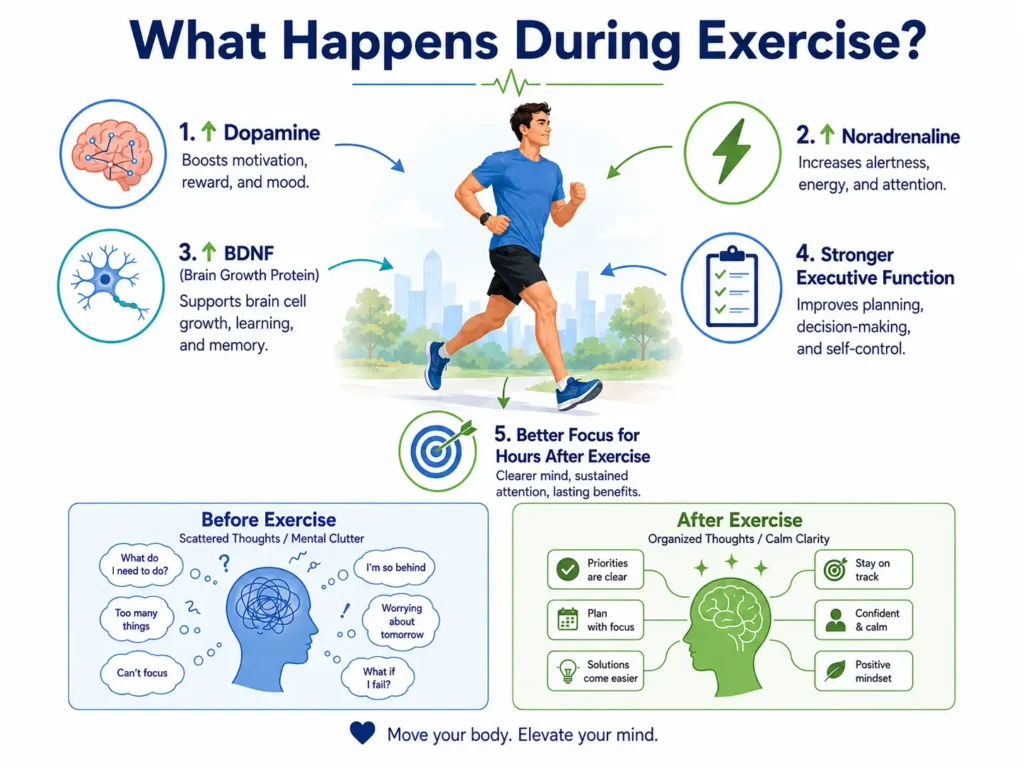
In the previous section, we talked about dopamine as your brain’s “this is worth doing” chemical. One of the reasons exercise is so effective for ADHD is because it directly influences that system. Intense exercise can increase dopamine levels by as much as 250%, and unlike the short-lived spike you get from scrolling social media or eating something sugary, the increase can last for several hours after you’ve finished exercising. At the same time, exercise also increases noradrenaline, another neurotransmitter that’s essential for attention, alertness and executive function. These are the same chemical systems targeted by ADHD medications, which is why so many people notice they can think more clearly after a workout.
If that temporary boost was the only benefit, exercise would already be one of the most powerful non-medication strategies available for ADHD. But what makes it truly remarkable is that it doesn’t just change how your brain functions today—it changes how your brain functions tomorrow.
Over the last decade, researchers have consistently found that people with ADHD who exercise regularly show measurable improvements in executive function, particularly working memory, inhibitory control and cognitive flexibility. Those terms sound technical, but you’ve experienced them every day. Working memory is what allows you to remember why you walked into the kitchen. Inhibitory control is what stops you from checking your phone halfway through writing an email. Cognitive flexibility is what helps you recover when your plans suddenly change instead of feeling completely overwhelmed. These are some of the exact abilities ADHD makes more difficult, and they’re also the abilities that improve most consistently in exercise research.
One reason appears to be a protein called brain-derived neurotrophic factor, or BDNF. Think of BDNF as fertiliser for your brain. Every time you learn a new skill, strengthen a habit or build a new neural pathway, BDNF helps support that process. Exercise increases the availability of BDNF, encouraging the brain to build stronger and more efficient connections, particularly in the prefrontal cortex—the area responsible for planning, decision-making and self-control. In other words, you’re not just giving your brain more dopamine for a few hours. You’re gradually making it better at regulating itself over the long term.
Interestingly, the type of exercise seems to matter as well. Activities like running, swimming and cycling are excellent for increasing dopamine and improving cardiovascular health, but sports that constantly force you to react to changing situations—such as tennis, basketball or martial arts—appear to provide an additional benefit. Because your brain is continuously making decisions, adapting to new information and controlling your movements, you’re exercising your executive functions at the same time as your body.
For me, this completely changed the way I think about exercise. I no longer see it as something I do to stay fit or burn calories. I see it as one of the most effective ways of improving the chemical environment my brain has to work with every single day. Once you understand that, going for a walk isn’t just “being healthy.” It’s one of the simplest and most evidence-based ways of making tomorrow’s ADHD a little easier to manage.
What this looks like in practice
- Aim for consistency rather than perfection. The long-term benefits seen in research come from exercising regularly over weeks and months, not from one intense workout followed by two weeks of inactivity.
- Use exercise strategically. If you have a task that requires deep concentration, try exercising beforehand. Many people find that the increase in dopamine and noradrenaline makes it easier to settle into focused work afterwards.
- You don’t need to spend hours in the gym. Studies have shown that even 20–30 minutes of moderate exercise can improve attention and executive function for several hours.
- Choose something you’ll actually keep doing. The best exercise for ADHD isn’t the one that’s theoretically optimal. It’s the one that you’ll still be doing six months from now.
Poor Sleep Doesn’t Just Make You Tired. It Makes ADHD Harder to Manage.
If I could convince every person with ADHD to change just one thing after reading this article, it would probably be to take their sleep more seriously.
Not because sleep is “healthy.”
Not because everyone should aim for eight hours.
But because poor sleep directly affects the very parts of your brain that ADHD already makes more difficult to use.
Think back to the previous section where we talked about the prefrontal cortex. This is the part of your brain responsible for planning, decision-making, impulse control, emotional regulation and working memory. It’s essentially your brain’s control centre, and it’s already under more strain in people with ADHD than it is in neurotypical brains.
Now here’s the part that completely changed the way I think about sleep.
The prefrontal cortex is also one of the first parts of the brain to suffer when you don’t get enough sleep.
Research has consistently shown that even a single night of poor sleep reduces activity in the prefrontal cortex and impairs executive functions such as working memory, decision-making and impulse control. If those functions sound familiar, it’s because they’re the same functions ADHD already affects. In other words, poor sleep isn’t creating a completely new problem. It’s amplifying the one you already have.
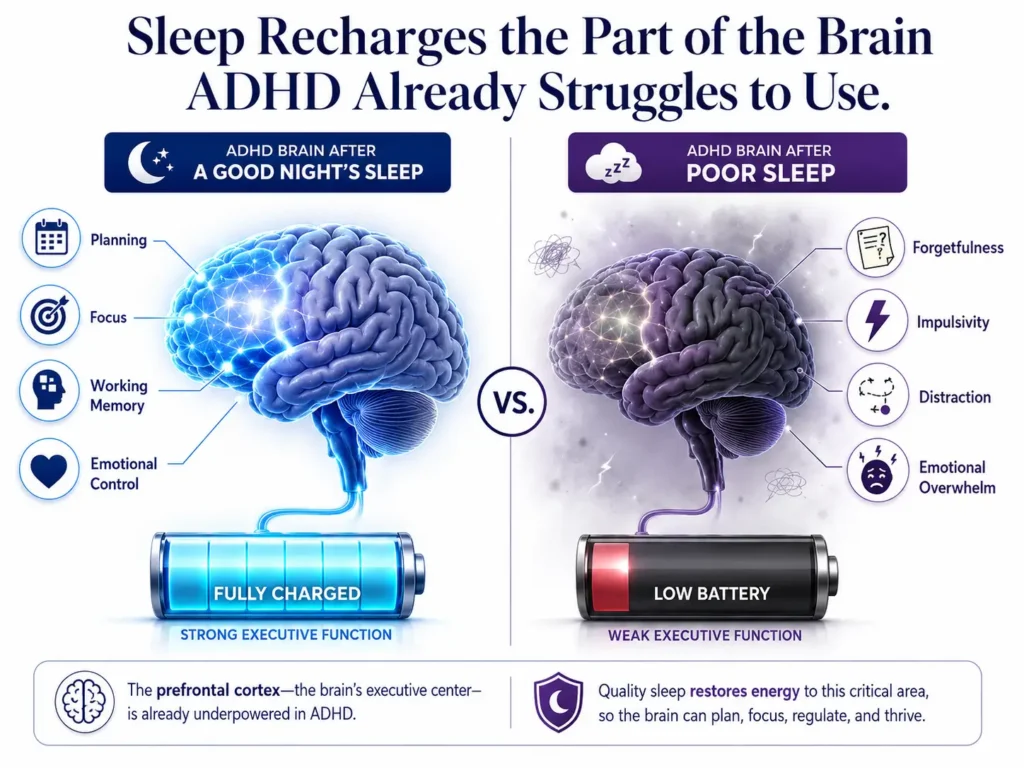
That’s why a bad night’s sleep can make your ADHD feel so much worse.
You become more impulsive.
It’s harder to hold information in your mind.
Small frustrations feel much bigger than they normally would.
Starting tasks requires even more effort.
Staying focused becomes almost impossible.
None of those things happen because you suddenly became lazy overnight. They happen because you’ve temporarily reduced the resources available to the part of your brain that’s responsible for regulating all of those abilities.
One analogy completely changed the way I think about this.
Think of your prefrontal cortex as the battery that powers your brain’s executive functions. Every decision you make, every impulse you resist, every distraction you ignore and every plan you successfully follow consumes a little bit of that battery.
If you have ADHD, you don’t necessarily wake up with a smaller battery—you simply drain it much faster because your brain has to work harder to perform the same executive functions.
Sleep is how you recharge that battery.
When you only sleep five hours, you don’t wake up at 100%. You start the day at 50 or 60%, then expect yourself to make good decisions, regulate your emotions, resist distractions and stay focused for the next sixteen hours.
It’s a bit like complaining your phone keeps dying halfway through the day while refusing to charge it overnight.
There’s another piece of this puzzle that’s worth knowing because it catches a lot of people with ADHD off guard.
Many people with ADHD naturally have a delayed circadian rhythm. In simple terms, their internal body clock genuinely prefers a later bedtime and wake-up time than society expects. This has been demonstrated repeatedly in ADHD research, which means struggling to fall asleep before midnight isn’t always a discipline problem. Sometimes it’s biology.
That doesn’t mean sleep doesn’t matter. If anything, it matters even more. The goal isn’t to force yourself into someone else’s ideal schedule. It’s to build a routine that gives your brain the recovery it needs as consistently as possible.
What this looks like in practice
- Protect your wake-up time. Waking up at roughly the same time each day helps anchor your circadian rhythm, even if you occasionally fall asleep later than planned.
- Reduce stimulation before bed. ADHD brains naturally seek novelty and stimulation. Bright screens, social media and YouTube give your brain exactly the opposite signal you want before sleep by encouraging it to keep searching for the next interesting thing.
- Take persistent sleep problems seriously. If you’ve always struggled to fall asleep at conventional times, mention it to your doctor. Delayed Sleep Phase Syndrome is significantly more common in people with ADHD and is often treatable.
- Treat sleep as part of your ADHD management, not separate from it. You’re not simply recovering from the day. You’re restoring the very brain functions you’ll rely on tomorrow.
Food Isn’t Just Fuel. It’s the Raw Material Your Brain Runs On.
Most of us grow up thinking about food in terms of calories, weight loss or physical health. We rarely stop to think about what that food is doing inside our brains, even though our brain is the organ responsible for every thought, decision, emotion and action we experience throughout the day.
Here’s something I didn’t appreciate until I started reading the research.
Dopamine doesn’t magically appear every morning when you wake up. Your brain has to manufacture it. One of the main ingredients it uses is an amino acid called tyrosine, which comes from protein-rich foods. That process also relies on nutrients such as iron, zinc and several B vitamins. In other words, your brain can’t build neurotransmitters out of thin air. It needs raw materials.
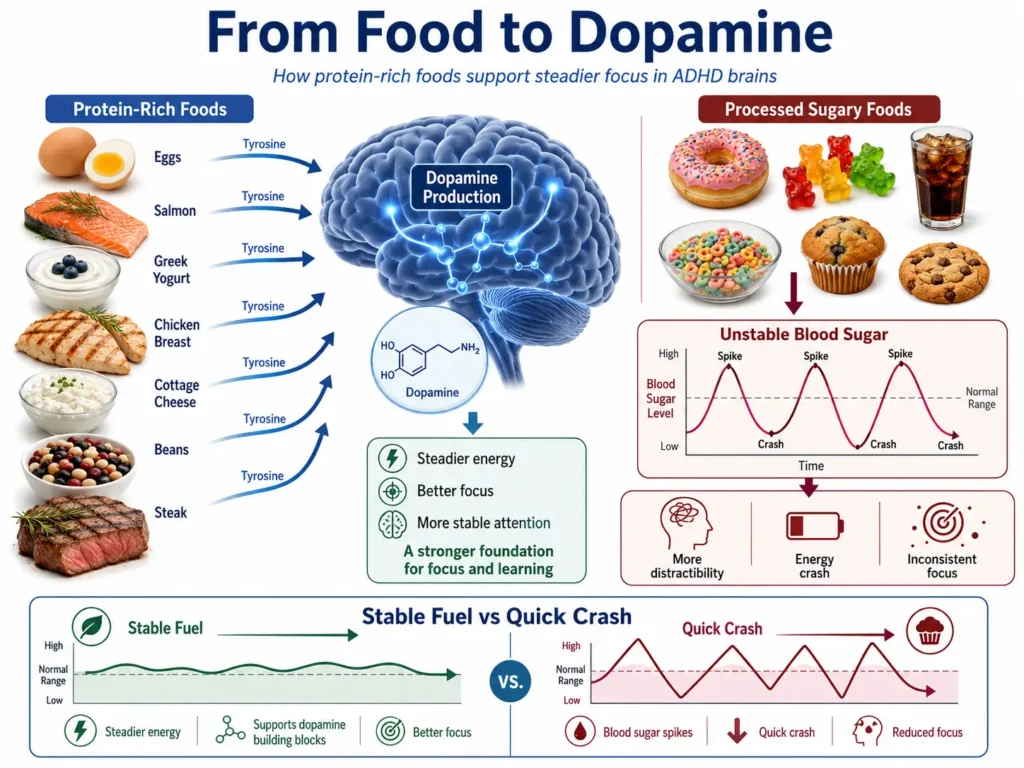
We’d never expect a builder to construct a house without bricks, yet many of us expect our brains to regulate attention, emotions, motivation and decision-making while regularly skipping meals or living on highly processed food. It sounds obvious when you say it out loud, but that’s exactly what many people with ADHD do every single day without realising it.
If ADHD already involves a brain that struggles to regulate dopamine, it makes very little biological sense to consistently deprive that brain of the nutrients it uses to produce dopamine in the first place. That doesn’t mean eating more protein will cure ADHD. Biology is far more complicated than that. But it does mean you’re giving your brain the materials it needs to perform one of its most important jobs.
That realisation completely changed the way I thought about food.
For years I skipped breakfast because I got distracted, survived on coffee until lunchtime, grabbed whatever was quickest when I eventually became hungry, and then wondered why my brain felt foggy, irritable and impossible to regulate by the afternoon. Looking back, I wasn’t just feeding my body poorly. I was expecting my brain to perform one of the most demanding cognitive jobs imaginable while giving it inconsistent raw materials and then blaming myself when it struggled.
The eating patterns themselves are also part of the ADHD story. Research suggests that around 70% of people with ADHD experience some form of disordered eating behaviour during their lifetime. That doesn’t necessarily mean a diagnosed eating disorder. More commonly, it looks like forgetting to eat until you’re starving, skipping meals because you became hyperfocused, emotionally eating during stressful periods, or constantly reaching for highly processed foods because they’re quick, stimulating and require almost no effort.
Once you understand how dopamine influences behaviour, those patterns become much easier to explain. When your brain is already searching harder for stimulation, highly processed foods become incredibly appealing because they provide a fast and reliable source of reward. Add in forgetting to eat for several hours, and it’s easy to end up trapped in a cycle of extreme hunger, impulsive food choices and the inevitable crash that follows.
Blood sugar is another piece of this puzzle that’s worth understanding. Imagine you skip breakfast, drink two coffees and eventually grab a sugary snack because you’re running late. Your blood sugar rises quickly, giving you a temporary burst of energy, before dropping just as quickly a short time later. For anyone that’s unpleasant. For an ADHD brain that’s already working harder to regulate attention and motivation, that crash often feels like someone has pulled the plug. Tasks that already felt difficult suddenly feel impossible, your patience disappears, and your brain starts searching for another quick source of stimulation.
You’re not imagining that feeling.
Your brain is trying to perform complex cognitive tasks while dealing with unstable energy on top of an already dysregulated reward system.
Omega-3 fatty acids deserve a quick mention because they’re often surrounded by exaggerated claims. The evidence is actually much more balanced than most articles suggest. Large meta-analyses have consistently found that people with ADHD tend to have lower blood levels of omega-3 fatty acids than people without ADHD. Supplementing with omega-3 isn’t a replacement for medication, nor is it a cure, but multiple reviews have found modest improvements in ADHD symptoms, particularly when supplementation is continued consistently over several months. It’s a small lever, not a miracle solution, and I think it’s important to be honest about that.
The bigger lesson isn’t really about protein or omega-3s.
It’s about recognising that your brain is a biological organ, not a machine that somehow functions independently of the choices you make every day.
Every time you sit down to eat, you’re making a decision about the quality of materials your brain will have available to build the neurotransmitters it depends on. Once I understood that, food stopped being about calories. It became one of the most direct ways I could influence how my ADHD showed up each day.
What this looks like in practice
- Prioritise protein early in the day. Your brain begins producing neurotransmitters long before your to-do list starts demanding your attention. Giving it a good source of protein in the morning means you’re providing the raw materials it needs before the day really begins.
- Reduce friction, not perfection. If mornings are chaotic, don’t aim for the perfect breakfast. Aim for the breakfast you’ll actually eat. Greek yogurt, cottage cheese, boiled eggs or a protein shake are infinitely better than skipping food because life got busy.
- Pay attention to your own blood sugar patterns. If your worst ADHD symptoms consistently appear after long gaps between meals or certain foods, you’ve found one of the simplest variables you can start experimenting with.
- If you decide to supplement with omega-3, think in months rather than days. The evidence suggests any benefits are gradual and come from consistent use over time, not from taking a capsule for a week.
Your Attention Needs Recovery, Not Just More Effort
If someone told you that taking a walk through a park could improve your attention, you’d probably nod politely and assume it was another piece of generic wellness advice.
“Fresh air is good for you.”
“Nature is relaxing.”
It sounds nice, but not particularly convincing.
The research tells a much more interesting story.
One of the most influential ideas in environmental psychology is called Attention Restoration Theory, and once you understand it, you’ll never look at a walk in the park the same way again.
The theory starts with a simple observation: not all attention is created equal.
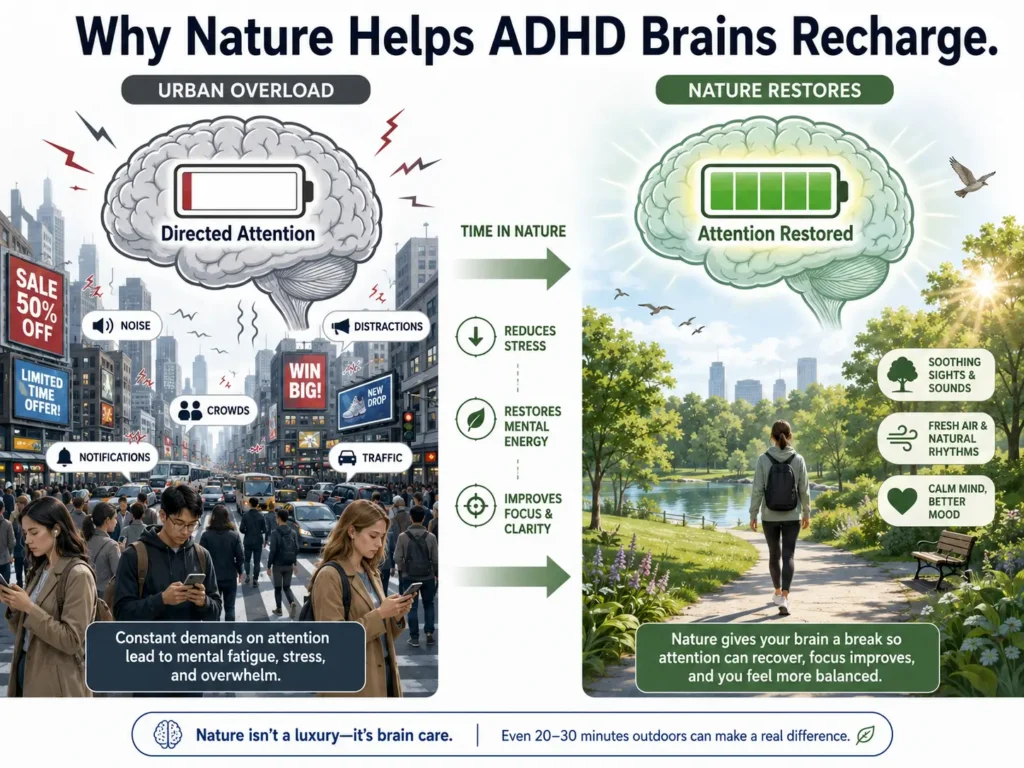
The attention you’re using to read this article is called directed attention. It’s the kind of attention you use whenever you’re trying to concentrate, ignore distractions, make decisions or force yourself through something that doesn’t come naturally. It’s hard work, and like any other limited resource, it eventually becomes depleted.
Then there’s another type of attention that psychologists call involuntary attention. This is what happens when you watch waves rolling onto a beach, stare into a campfire or notice leaves moving in the wind. You’re paying attention, but you’re not making yourself pay attention. The environment gently holds your focus without asking your brain to work for it.
That distinction turns out to matter far more than most people realise.
Your prefrontal cortex—the same part of the brain we’ve already talked about several times—is constantly using directed attention. Every time you resist checking your phone, remember what you walked into the kitchen for or force yourself to finish a boring task, you’re spending a little more of that limited resource.
Nature gives that system a chance to recover.
Researchers have tested this idea directly in children with ADHD by asking them to take walks in three different environments: a park, a quiet residential neighbourhood and a busy downtown area. After each walk, the children completed attention tests. The results surprised even the researchers. Attention improved after all three walks, but the improvement was greatest after walking through the park. In fact, the size of the improvement was comparable to what has been reported in studies of stimulant medication.
That doesn’t mean a walk in the park replaces medication. It doesn’t, and no serious researcher is making that claim.
What it does tell us is something equally important.
A simple walk through a green environment can provide meaningful cognitive relief for an ADHD brain, and it costs nothing.
The research becomes even more fascinating when you zoom out. One of the largest studies ever conducted on this topic followed more than 800,000 children and found that those who grew up surrounded by more green space were significantly less likely to be diagnosed with ADHD later in life. While that doesn’t prove that nature prevents ADHD, it strongly suggests that our environment has a much bigger influence on attention and brain development than most of us realise.
There are probably several reasons for this. Green spaces reduce stress, and stress itself makes ADHD symptoms worse by placing even greater demands on the prefrontal cortex. At the same time, natural environments allow directed attention to recover instead of demanding more from it. In other words, a walk through the park isn’t simply giving you exercise. It’s giving one of the hardest-working parts of your brain an opportunity to recharge.
Once I understood that, I stopped thinking of walks as “taking a break.”
I started thinking of them as maintenance for my brain.
What this looks like in practice
- You don’t need a forest. Most of the studies used ordinary parks and neighbourhoods with trees. The goal isn’t wilderness—it’s giving your brain exposure to natural environments.
- Use nature before demanding work. If you know you need to concentrate for the next few hours, try taking a 20-minute walk beforehand. You’re not procrastinating. You’re helping your brain recover the attention you’ll need for the task ahead.
- Pay attention to your energy dips. If your concentration consistently falls apart in the middle of the afternoon, that’s often the perfect time for a short walk outside instead of another coffee or twenty minutes of scrolling.
- Remember that these strategies stack. A walk through a park isn’t just movement. You’re increasing dopamine through exercise while giving your directed attention a chance to recover at the same time.
Cognitive Behavioural Therapy Isn’t About Changing Your Past. It’s About Changing How You Work With Your Brain.
When people hear the word therapy, they often picture sitting on a sofa talking about childhood memories or difficult emotions. While that can be incredibly valuable, it’s not what ADHD-adapted Cognitive Behavioural Therapy (CBT) is primarily about.
ADHD-specific CBT is much more practical than most people realise. It’s less interested in asking “Why did this happen?” and much more interested in asking “What happened between deciding to do the task and not doing it?”
That might sound like a small difference, but it’s enormous.
Imagine you’ve been meaning to book a dentist appointment for three weeks. A traditional way of thinking might conclude that you’re unmotivated or disorganised. ADHD-adapted CBT becomes curious instead. Did you forget because it never made it into a calendar? Did the task feel too vague to start? Did you keep remembering at times when you couldn’t actually make the call? Did you become distracted halfway through? Each of those problems has a different solution, and none of them have anything to do with laziness.
That’s why CBT works so well for ADHD.
It isn’t trying to convince you to “try harder.” It’s helping you identify exactly where the process breaks down so you can build a system that prevents it happening next time.
The evidence for this approach is remarkably strong. Multiple systematic reviews and meta-analyses of randomised controlled trials have found that ADHD-adapted CBT produces meaningful improvements in core ADHD symptoms, executive functioning and daily life. What’s particularly encouraging is that these improvements are seen not only in self-reported questionnaires but also in clinician-rated assessments, suggesting people aren’t just feeling more optimistic—they’re genuinely functioning better.
One of the reasons CBT is so effective is that it addresses something many of us don’t even realise we’ve developed over the years.
Living with ADHD often means accumulating hundreds of small failures that gradually become part of your identity. Forgotten birthdays. Missed deadlines. Half-finished projects. Promises you genuinely intended to keep but somehow didn’t. After enough of those experiences, it’s easy to stop seeing them as individual events and start believing they’re evidence that you’re lazy, unreliable or incapable.
Those beliefs become a problem in their own right.
Imagine sitting down to start an important project while a voice in the back of your mind quietly reminds you, “You’ll probably give up halfway through like you always do.” That’s not ADHD. That’s years of frustration shaping the way you see yourself, and it makes starting even harder.
CBT helps separate the condition from the story you’ve built around the condition.
Instead of saying, “I always ruin everything,” you begin asking much more useful questions.
“What made this task difficult?”
“Where exactly did the process fall apart?”
“What system would make that less likely next time?”
That’s a completely different way of approaching ADHD.
Over time, those questions become more valuable than self-criticism because they lead to solutions instead of guilt.
In many ways, that’s also the philosophy behind ADHD Bright. The goal has never been to create another planner that expects you to suddenly become organized. The goal is to reduce the amount your brain has to remember, plan and regulate on its own by building external systems that quietly support you throughout the day.
Once you stop expecting your brain to do everything internally, you free it up to do what it does best.
Every section in this article has been about reducing the demands placed on your brain. CBT simply does it from a different angle. Instead of changing your biology through sleep, food or exercise, it changes the systems and thought patterns that determine how much work your brain has to do every day.
What this looks like in practice
- Look for ADHD-adapted CBT if possible. Traditional CBT can still be helpful, but therapists trained specifically in ADHD tend to focus much more on executive function, habits and practical systems.
- If therapy isn’t accessible, many of the same skills can still be learned. ADHD workbooks, coaching and structured self-help resources often teach techniques such as task breakdown, implementation intentions, self-monitoring and habit design.
- Remember that the goal isn’t to change who you are. It’s to build systems that make your success less dependent on memory, motivation and perfect timing.
Your Brain Was Never Meant to Hold the Plan
If there’s one piece of advice that almost every ADHD expert agrees on, regardless of whether they recommend medication, therapy or coaching, it’s this:
Stop trying to keep everything in your head.
That might sound disappointingly simple, but there’s a very good reason it’s repeated so often. It’s not because people with ADHD are forgetful. It’s because your brain is trying to use a system that was never designed to carry that much information in the first place.
To understand why, we need to go back to working memory.
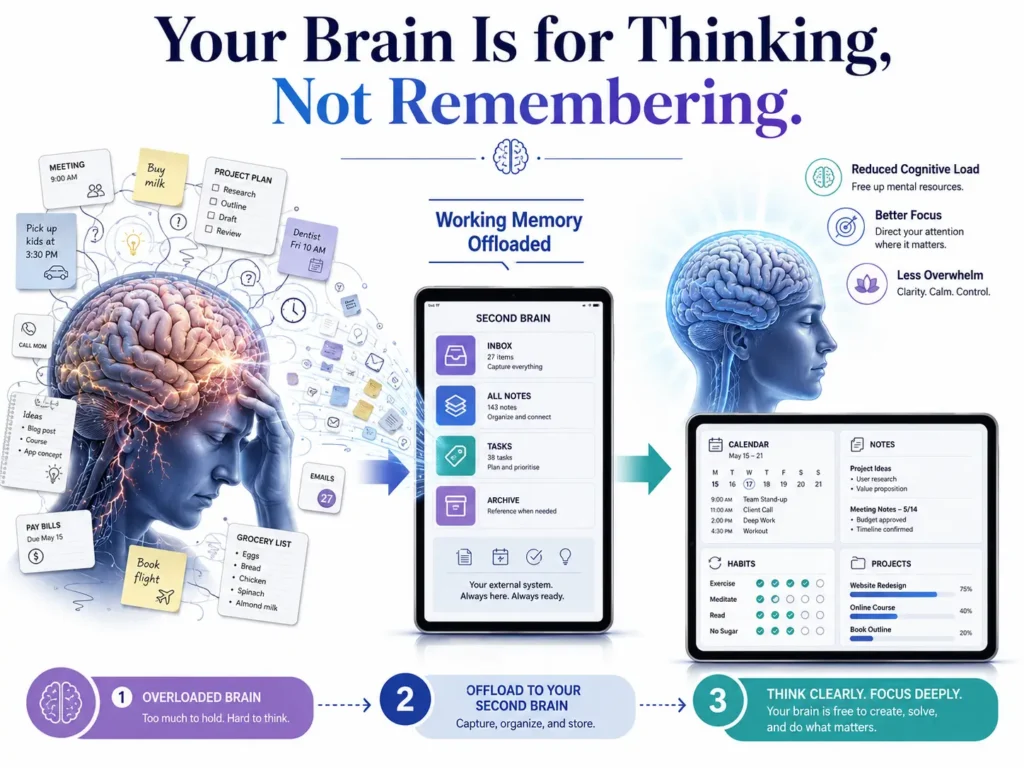
Earlier, we talked about working memory as one of the executive functions most affected by ADHD. Despite the name, it isn’t really about memory in the way most people think of it. It’s more like your brain’s temporary workspace. Every time you remember why you walked upstairs, mentally rehearse what you’re about to say in a meeting, or keep track of three things you need to buy from the supermarket without writing them down, you’re using working memory.
Dr. Russell Barkley describes working memory as your brain’s internal GPS. I think that’s a brilliant analogy because a GPS doesn’t drive the car—it keeps reminding you where you’re trying to go. Without it, it’s surprisingly easy to miss a turning, get distracted by something else and suddenly realise you’re miles away from your destination.
That’s exactly what happens in ADHD.
The intention was real.
You genuinely meant to book the appointment.
You genuinely meant to send the email.
You genuinely meant to buy toothpaste.
The problem wasn’t that you didn’t care.
The problem was that your brain was trying to hold onto those intentions while simultaneously responding to dozens of other thoughts, distractions and decisions throughout the day. Eventually something more immediate captured your attention, and the original plan quietly disappeared.
That isn’t a character flaw.
It’s exactly what we’d expect from a brain with differences in working memory and executive function.
Once you understand that, something interesting happens.
You stop asking,
“How can I remember more?”
and start asking,
“Why am I expecting my brain to remember all of this in the first place?”
That’s the question that changed the way I organise my life.
For years I thought a planner was supposed to make me more organised.
Now I see it completely differently.
A planner isn’t there to help you remember.
It’s there so you don’t have to remember.
That’s an important distinction.
The moment your brain has to remember to remember something, you’ve already placed the burden back onto the very system that’s struggling in the first place.
That’s why so many planning systems fail. They become another thing your brain has to keep track of instead of removing that responsibility altogether.
The best systems all follow the same principles.
They capture information the moment it appears instead of trusting your brain to hold onto it until later.
They bring everything into one trusted place instead of scattering it across sticky notes, three different apps and yesterday’s shopping receipt.
They break overwhelming projects into actions that are so small your brain doesn’t have to work out where to begin every time you look at them.
Most importantly, they become part of your environment instead of living quietly inside your head.
That’s the idea behind externalising your brain.
You’re not becoming dependent on a planner.
You’re moving information from an unreliable storage system into a reliable one.
When you think about it like that, using a planner stops feeling like admitting defeat.
It starts feeling like wearing glasses when your eyesight isn’t perfect.
Nobody considers glasses a weakness.
They’re simply a tool that allows your eyes to do their job more effectively.
An external planning system does exactly the same thing for working memory.
It doesn’t replace your brain.
It supports it.
One of the biggest mistakes people with ADHD make is treating their brain like a storage device. It isn’t. Your brain is for generating ideas, solving problems and being creative. Your planner is for remembering things. The moment you stop asking one system to do the other’s job, life becomes dramatically less overwhelming.
If you want a more practical breakdown of how to turn this idea into daily action, I also wrote a full guide on ADHD productivity strategies that help you get things done without relying on willpower. It covers simple ways to reduce friction, manage tasks, work with your energy, and build systems that actually fit an ADHD brain.
What this looks like in practice
- Capture first, organise later. The moment a task or idea appears, get it out of your head. Don’t trust yourself to remember it after you’ve finished what you’re doing.
- Keep one trusted system. If your tasks live in four different places, you’ve recreated the very problem you’re trying to solve.
- Always define the next action. “Write the report” is too vague. “Open the report and write the introduction” gives your brain somewhere concrete to begin.
- Review your system at the same time every day. Don’t rely on remembering to check your planner. Attach it to something that already happens automatically, like your morning coffee or sitting down at your desk.
The Goal Was Never to Become More Disciplined
If you’ve noticed a common theme throughout this article, it isn’t exercise, sleep, nutrition or planners.
It’s that every single strategy works by making your brain’s job easier.
Exercise increases neurotransmitters like dopamine and noradrenaline that help your brain regulate attention. Sleep restores the prefrontal cortex so it has the resources to plan, focus and control impulses the next day. Protein provides the raw materials your brain uses to build neurotransmitters. Time in nature allows your directed attention to recover instead of asking it to keep working when it’s already exhausted. External systems and ADHD-adapted CBT reduce the amount your working memory has to carry, freeing your brain to focus on the things that actually matter.
None of these strategies work because they magically make you more disciplined.
They work because they change the environment your brain is operating in.
For years, I believed managing ADHD meant trying harder. Every failed planner, abandoned routine and forgotten task felt like evidence that I simply wasn’t disciplined enough. Looking back, I wasn’t failing because I didn’t care. I was asking my brain to do jobs it wasn’t well suited to doing on its own.
That’s the biggest lesson this journey has taught me.
Your brain isn’t asking you to become a different person.
It’s asking you to understand how it works.
Once you understand that, healthy habits stop feeling like punishment. Going for a walk isn’t about burning calories. Eating enough protein isn’t about following another diet. Getting enough sleep isn’t about being “good.” They become ways of looking after the organ that shapes every thought, decision and emotion you experience.
Does that mean they’ll suddenly become effortless?
Of course not.
Living with ADHD will probably always require more intentionality than you’d like. There will still be days when you skip the workout, stay up too late or forget to check your planner. That doesn’t mean you’ve failed. It simply means you’re human, and you’re living with a brain that naturally struggles with consistency.
The goal was never perfection.
The goal was always progress.
So don’t try to change everything tomorrow.
Instead, think back through this article and ask yourself one question:
Which section made you stop and think, “I’ve never looked at it that way before”?
Start there.
Real, lasting change rarely comes from overhauling your entire life overnight. It comes from understanding one thing deeply enough that your behaviour naturally begins to change. Once you stop fighting your brain and start supporting it, those small changes begin to compound. Over time, they don’t just change your habits—they change the way your ADHD shows up in your everyday life.
That’s exactly why I created ADHD Bright.
Not because I believe a planner can “fix” ADHD, but because I believe your brain was never meant to carry everything on its own. Sometimes the most effective thing you can do isn’t trying harder—it’s building a system that quietly supports you on the days your brain needs it most.
Medical Disclaimer
This article is intended for educational purposes only and should not be considered medical advice. ADHD is a complex neurodevelopmental condition, and what works for one person may not work for another. Always speak with a qualified healthcare professional before starting, stopping or changing any medication, supplements or treatment plan. If ADHD symptoms, sleep problems or your mental health are significantly affecting your daily life, seeking professional support is one of the most important steps you can take