
Productivity with ADHD isn’t about “trying harder.” It’s about working with your brain. ADHD brains are motivated differently, energized differently, and distracted differently—which means traditional productivity advice often falls flat.
If you’ve ever wondered why simple tasks feel complicated, or why motivation comes in unpredictable waves, it’s not a flaw—it’s neurology. ADHD productivity becomes dramatically easier once you build systems around clarity, dopamine, energy, and structure.
Here’s how to be productive with ADHD in a way that feels doable, motivating, and sustainable.
1. Start With Clarity: Know Exactly What You Need to Do Today
One of the biggest productivity killers for ADHD is vague plans. “I need to work on the project” is overwhelming. But “Write slide #1” is doable.
ADHD brains struggle with working memory—holding multiple steps in mind at once—which makes daily clarity essential. Externalizing information through lists or systems reduces cognitive load and boosts follow-through.
This principle is the foundation of ADHD Bright’s “Second Brain” approach, which exists to offload mental clutter so you can focus on execution.
Try This:
- Write your 3 most important tasks for the day.
- Break each into the smallest possible step.
- Ask: “What does starting actually look like?”
When your brain sees the next clear step, getting started becomes 10x easier.
If productivity feels impossible because you don’t know where to start, this guide will help you find clarity fast:
Task Overwhelm and ADHD: How to Find Clarity Fast
2. Plan Your Day Around Your Energy (Not the Clock)
People with ADHD often experience energy variability, which means your best focus hours aren’t always when society says they should be.
Instead of forcing productivity at the “wrong” time, plan around your natural rhythm.
Ask yourself:
- When is my brain sharpest?
- When am I usually sluggish?
- When do I need breaks the most?
This is where timeboxing becomes a powerful ADHD-friendly tool.
Instead of rigid schedules, timeboxing assigns when you will work on something—helping you overcome time blindness and reduce overwhelm. It’s especially effective for ADHD brains because it provides structure without rigidity.
Pair high-energy windows with mentally demanding tasks, and low-energy windows with lighter tasks or activations like movement or tidying.
If you want a deeper explanation of timeboxing as an ADHD-friendly planning method, read:
How to Use Timeboxing for ADHD
3. Limit “Bad Dopamine”: Reduce Scrolling & Digital Distractions
Productivity with ADHD is directly tied to dopamine. Activities like scrolling give fast dopamine, while task initiation requires slower, effort-based dopamine.
When you flood your brain with high-speed dopamine early in the day, tasks feel harder, more boring, and more frustrating.
Simple ways to protect your focus:
- Use app blockers like Stay Focused or Freedom
- Store your phone in another room during deep work
- Disable notifications during work blocks
- Try “dopamine-neutral” breaks (tea, stretching, walking)
Distraction control is not about discipline—it’s about designing an environment your brain can succeed in.
4. Keep Your Workspace Distraction-Free
Visual clutter equals mental clutter—and ADHD brains are highly sensitive to environmental cues. Research supports that simplified environments reduce cognitive overload and improve focus.
ADHD Bright’s entire design philosophy is built on this neuroscience:
clean layouts, minimal decision points, and low visual noise dramatically reduce overwhelm.
Make your workspace ADHD-friendly:
- Clear the desk except for what you’re working on now
- Use trays or bins to contain visual clutter
- Keep a “capture notebook” nearby for intrusive thoughts
- Remove items that compete for attention (open tabs, objects, etc.)
Your brain will thank you.
5. Fuel Your Brain: Eat 30g of Protein With Each Meal
Productivity isn’t just mental—it’s metabolic. ADHD brains rely heavily on stable dopamine and blood sugar to maintain focus. Skipping meals or eating mostly carbs can cause:
- Brain fog
- Irritability
- Crash cycles
- Poor emotional regulation
- Reduced attention span
High-protein meals stabilize cognitive performance and improve sustained focus.
This is why ADHD Bright’s meal planning system emphasizes high-protein, low-effort meals—because consistent fueling is one of the fastest ways to boost productivity.
Aim for:
✔️ 25–30g of protein at breakfast
✔️ 30g+ at lunch and dinner
✔️ Easy snacks like eggs, yogurt, tuna, nuts, jerky, or protein smoothies
Food is focus.
6. Pair Tasks With Dopamine Rewards
ADHD productivity thrives on reward loops.
Small, immediate rewards create dopamine hits that reinforce habits and make it easier to start next time.
This concept is backed by neuroscience: dopamine-friendly progress visuals dramatically improve consistency and follow-through in ADHDers.
Examples of dopamine-paired routines:
- Workout ➝ favorite breakfast afterward
- Finish 1 task ➝ make a matcha latte
- Complete a work block ➝ 5-minute walk in the sun
- Send a scary email ➝ watch a funny video
This isn’t bribing yourself—it’s using your neurology strategically.
7. Identify What Triggers Your Dysregulation (and Avoid It)
ADHD productivity often sinks when emotional dysregulation gets activated. Understanding your patterns—what overstimulates you, overwhelms you, or sends you into shutdown—helps you avoid pitfalls.
CBT-inspired journaling helps ADHDers recognize emotional and environmental triggers, challenge unhelpful thought patterns, and respond more intentionally.
Common dysregulation triggers:
- Rushing
- Feeling behind
- Unexpected task-switching
- Noise or clutter
- Hunger
- Conflict
- Rejection sensitivity
- Decision overload
When you know the triggers, you can design your day to buffer against them.
Pair this with reflective practices to understand your patterns better using journaling prompts specifically created for ADHD: 5 Journaling Prompts for ADHD
8. Build Routines That Reduce Decisions
Every decision your brain has to make costs mental energy. ADHD brains hit decision fatigue faster, which leads to avoidance, procrastination, or overwhelm.
Routines remove the need for constant decision-making and create an “autopilot” path through your day. This is why checklists and prebuilt routines are a core part of ADHD Bright—they reduce cognitive load and preserve energy.
Try building simple routines for:
- Morning start-up
- Workday shutdown
- Meals
- Bedtime wind-down
- Weekly reset routines
Structure saves energy.
Need help building routines that support clarity? Learn how to design systems that run your day on autopilot in my guide: Build ADHD Routines That Run Your Day on Autopilot
9. Keep Your System Simple and Forgiving
You don’t need a complicated productivity system.
You need one that’s:
- visual
- quick to use
- easy to return to after you fall off
- dopamine-rewarding
- low friction
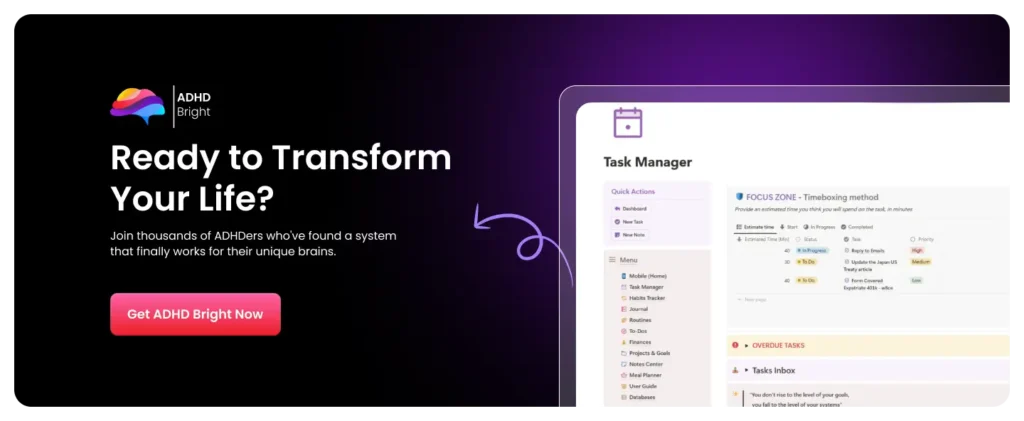
This is exactly why the ADHD Bright planner is built on neuroscience—not aesthetics.
It reduces overwhelm, externalizes memory, gamifies progress, and minimizes decision fatigue.
The right system isn’t the one you use on perfect days.
It’s the one that works even on the messy ones.
Productivity With ADHD Is a Science, Not a Mystery
When you understand what your brain needs—clarity, structure, dopamine, routine, nourishment, and simplicity—productivity becomes dramatically more achievable.
You don’t need more willpower.
You need the right environment, the right tools, and the right strategies.
And once you have those?
You become unstoppable.
Research confirms that ADHD brains process motivation and dopamine differently, affecting task initiation and consistency. According to the National Institute of Mental Health, ADHD impacts executive functioning and emotional regulation in measurable neurological ways.
Source: NIMH – ADHD