

Project planning with ADHD can feel like trying to organize fireworks—exciting, explosive, chaotic, and gone in 20 directions at once. You want to start. You know it matters. Yet somehow, you get stuck between overwhelm, 50 ideas, and sudden urges to clean your entire kitchen instead.
This isn’t laziness.
This is ADHD.
ADHD brains struggle with working memory, task initiation, time prediction, and—most importantly—emotional regulation. Big projects press on all four.
The good news?
With the right structure, any project becomes doable. Not by using more willpower, but by building a system that works with your brain.
Below are the most ADHD-friendly project planning strategies that actually work in real life—not theory.
1. Start With a Brain Dump (Your Brain Needs the Offload)
Before you plan, before you schedule, before you break things down… empty your brain.
Why it works:
ADHD brains get overwhelmed holding multiple pieces of information at once. Offloading reduces cognitive load and instantly calms your nervous system.
What to brain dump:
- everything you think you need to do
- tasks you’re avoiding
- details you must remember
- steps, however small or silly
- ideas, concerns, unknowns
Don’t organize yet.
Don’t judge the list.
Just externalize.
If you’re still figuring out what planning system supports your brain best, this guide to the best ADHD planners for adults can help you compare what actually works in real life.
2. Group Tasks Into Phases (The ADHD-Friendly Structure)
Once you’ve dumped everything out, group your tasks into phases. ADHD brains love structure, but only after the chaos is out.
Common project phases might be:
- Prep
- Research
- Execution
- Editing/Revising
- Finalizing
- Submitting/Sharing
This turns the blurry blob of “the project” into a clear sequence your brain can understand.
3. Break Tasks Down Until They Feel “Laughably Easy”
This is the most important ADHD-specific step.
If a task feels vague or big, your brain will avoid it.
Even something simple like “make slides” is too big for an ADHD brain.
Break everything down until it becomes obvious what to do.
Examples:
❌ Write the report
✔️ Make bullet outline
✔️ Draft section 1
✔️ Draft section 2
✔️ Insert data
✔️ Add introduction
✔️ Proofread 10 minutes
If you think, “This step is too small,” you’re doing it right.
If breaking tasks down still feels overwhelming, this article on task overwhelm and ADHD explains why your brain freezes—and how to create steps that feel manageable.
4. Set Realistic Deadlines (Not Fantasy Deadlines)
ADHDers chronically underestimate time.
This creates unnecessary shame cycles.
Instead of saying:
“I’ll do all of this tomorrow,”
Try:
- How long might this actually take?
- What’s the baseline?
- What’s the buffer?
- What is the minimum I can commit to?
Give yourself more time than you think you need, not less.
If time blindness makes estimating or scheduling project steps difficult, this guide on ADHD time management breaks down practical ways to work with the way your brain understands time.
5. Reverse-Engineer the Project (Work Backwards)
ADHD brains struggle to start vague tasks.
So flip the process:
- Define what “done” looks like.
- Ask: “What must happen immediately before that?”
- And before that?
- And before that?
This creates a clear, linear path that reduces ambiguity and decision fatigue.
6. Start With the Emotion, Not the Task
This is the part most planning methods skip—but ADHDers can’t.
ADHD project avoidance is rarely about the task.
It’s about the feeling attached to the task.
Ask yourself:
- What emotion do I feel when I think about starting?
- What am I afraid might happen?
- What past experience does this remind me of?
- What would make this feel safer?
- What tiny step would ease me in?
Addressing the emotion first makes the task easier to start and sustain.
7. Visualize Yourself Finishing (Dopamine Activation)
This isn’t fluff. Visualization triggers the dopamine and motivation networks that ADHD brains rely on to take action.
Close your eyes and imagine:
- the moment you finish
- how your body feels
- the relief
- the pride
- the impact it will have
- the version of yourself who got it done
This builds emotional momentum—something ADHD brains need before execution.
8. Use “Warm-Up Tasks” to Break the Avoidance Loop
If starting feels impossible, don’t start with the project.
Start with a tiny activation task:
- Open the document
- Set the timer
- Gather materials
- Re-read the instructions
- Write the project title
- Make a 3-step mini-plan
ADHD brains often only need a small spark to transition out of avoidance.
9. Schedule Weekly Check-Ins (Your ADHD Weekly Reset)
This step prevents the “I forgot this project even existed” spiral.
Once a week, review:
- what you did
- what you underestimated
- what needs adjusting
- the next small step
ADHD project planning is not one-and-done—it evolves.
If you want a routine that helps you stay on track without starting from zero each time, here’s a simple ADHD weekly reset routine you can use to refresh your projects every week.
10. Let Your Identity Lead the Project (Not Pressure)
Instead of forcing discipline, ask:
- Who am I becoming by completing this?
- What identity does this project reinforce?
- What does my future self gain?
ADHD brains are more motivated by identity and emotional meaning than by obligation.
11. Celebrate Every Micro-Milestone
ADHD motivation runs on dopamine.
Instead of waiting until the final result, reward yourself when you:
- complete a phase
- finish a tough task
- overcome avoidance
- estimate time accurately
- make progress even when dysregulated
Small consistent rewards build long-term momentum.
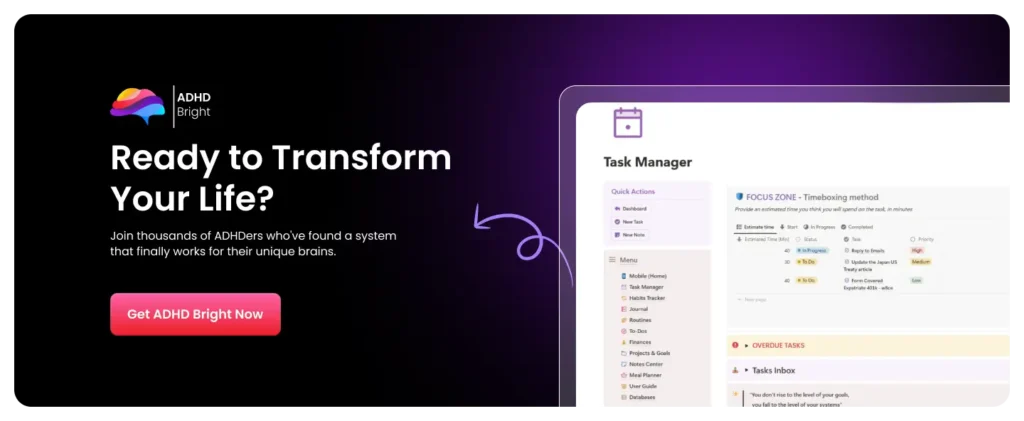
If you want a tool that helps you structure projects like this—
with brain dumps, breakdown templates, timeboxing, visualization prompts, and emotional check-ins built in—ADHD Bright includes a project planning system designed around ADHD neuroscience and CBT principles.
Not a requirement.
Just something that exists if you want support.