There is a kind of ADHD advice that sounds simple until you try to live it.
Eat better. Stop eating sugar. Meal prep. Don’t snack so much. Just make healthier choices.
If you have ADHD, you probably already know what a “healthy meal” looks like. The problem is rarely lack of information. The problem is that food sits right in the middle of almost every ADHD difficulty at once: dopamine, impulsivity, executive function, emotional regulation, planning, sensory preferences, time blindness, fatigue, and the very real fact that cooking requires a shocking number of steps before you even get to eat.
That is why nutrition for ADHD cannot be treated like a normal wellness topic.
For many ADHDers, food is not just fuel. Food is stimulation. Food is comfort. Food is procrastination. Food is dopamine. Food is something you forget about all day and then suddenly need urgently. Food is also one of the most direct ways you can either support your brain chemistry or make your symptoms harder to manage.
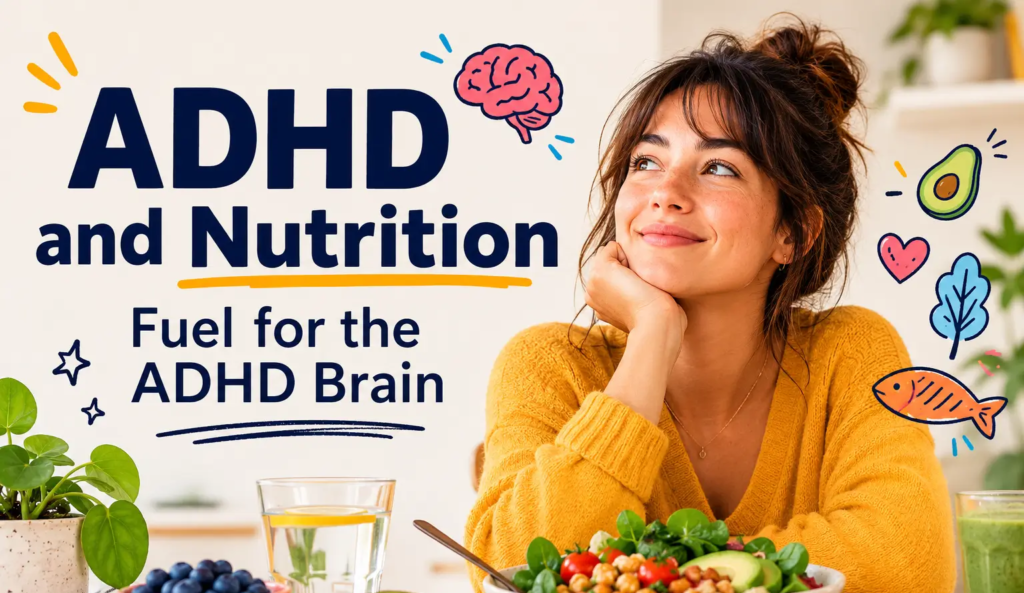
This article is a deeper companion to my guide, “How to Manage ADHD Without Medication: Evidence-Based Strategies That Actually Work.” In that article, nutrition is one of the most important non-medication strategies because it affects the same systems ADHD already struggles with: attention, reward, energy, mood, sleep, and self-regulation.
I also want to say this honestly from the start: this article is not about moralising food. I have personally struggled with binge eating disorder that was deeply connected to my ADHD. The taste of chocolate and sweets could make me feel like I had lost my mind, not because I was weak, but because my brain had learned to use highly rewarding food as stimulation, relief, and regulation. I’ll share that story properly in another article if there’s interest, so please email me if you want that. I genuinely love hearing from you guys.
This article is about understanding the mechanism, because once you understand what food is doing to your ADHD brain, eating better stops feeling like punishment and starts feeling like protection.
The ADHD Food Problem Is Not Just “Bad Choices”
A lot of ADHDers have some form of distorted, irregular, impulsive, or emotionally loaded eating. You may hear the statistic that around 70% of people with ADHD struggle with some kind of disordered or dysregulated eating pattern, but it is important to define what we mean by that. That number usually refers broadly to patterns such as skipping meals, forgetting to eat, bingeing, grazing, emotional eating, relying on ultra-processed foods, chaotic meal timing, or feeling out of control around certain foods. Clinical eating disorder diagnoses are a narrower category, but research is very clear that ADHD and disordered eating overlap far more than chance would predict.
A systematic review of 75 studies found moderate-strength evidence for a positive association between ADHD symptoms and disordered eating, especially overeating behaviours. Another meta-analysis found that people with ADHD had about a 3.8-fold increased risk of an eating disorder compared with people without ADHD, and ADHD has been specifically linked with binge eating and emotional eating in multiple samples.
That should change the tone of the conversation immediately.
If you have spent years feeling confused by your eating, this is not because you are uniquely undisciplined. ADHD directly affects the systems that make eating regular, intentional, and balanced. The same brain that forgets appointments can forget meals. The same brain that struggles with impulse control can struggle to stop eating once a highly rewarding food has started. The same brain that seeks novelty can become bored by repetitive meals. The same brain that crashes emotionally can reach for food because it is one of the fastest ways to change state.
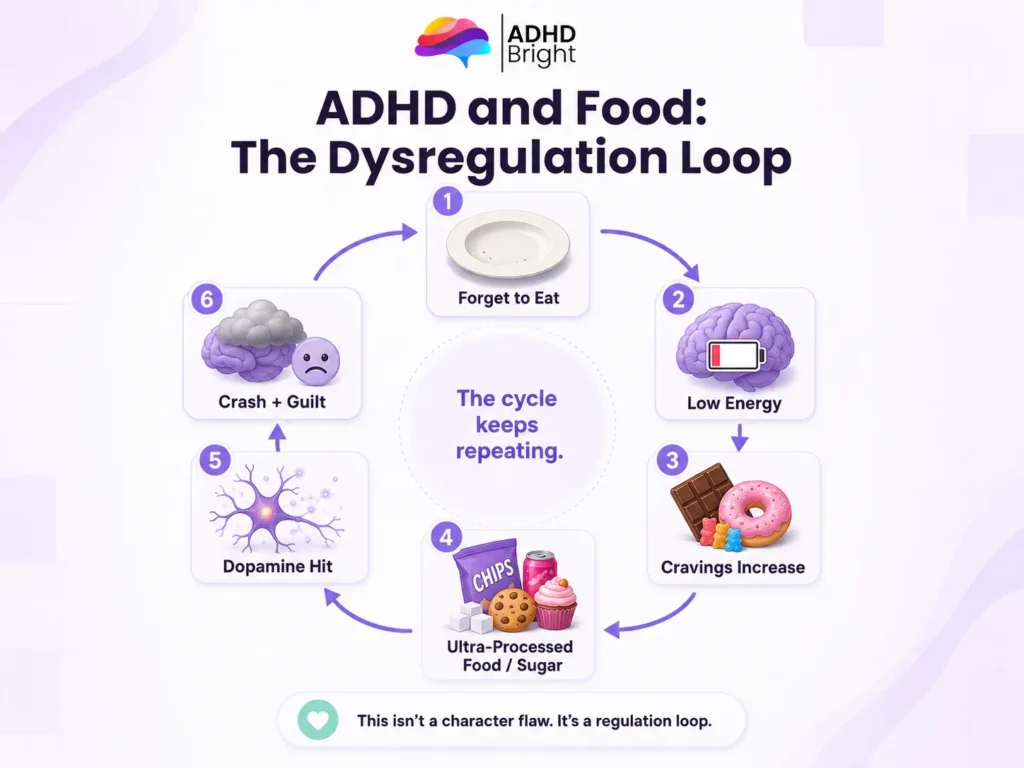
This does not remove responsibility, but it removes shame. And shame is a terrible strategy for ADHD because it usually leads to the exact cycle we are trying to escape: dysregulation, avoidance, impulsive relief, guilt, and then more dysregulation.
Food Is Not Just Calories. It Is Brain Chemistry.
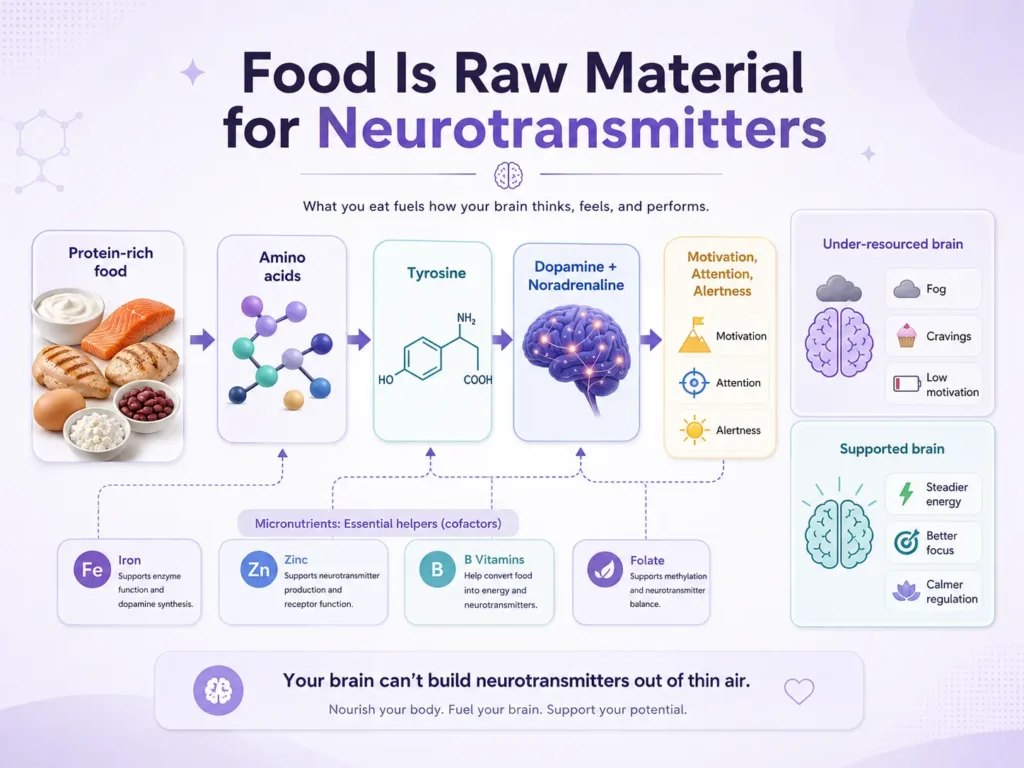
The first mental model to change is this: food is not just fuel for your body. Food is raw material for your neurotransmitters.
Your brain does not produce dopamine, noradrenaline, serotonin, acetylcholine, or GABA out of thin air. It builds and regulates these chemical messengers using nutrients that come from food. Dopamine, for example, is made from the amino acid tyrosine, which comes from protein-rich foods. That conversion process also depends on micronutrients such as iron, zinc, folate, vitamin B6, and other cofactors. Nutrition reviews on ADHD consistently discuss the role of dietary patterns, fatty acids, minerals, vitamins, and amino acids in brain function, although the evidence is stronger for some interventions than others.
This is the part that changed everything for me.
If ADHD already involves differences in dopamine and reward signalling, it makes very little sense to run that brain on a diet that gives it unstable energy and fewer building blocks for the neurotransmitters it already struggles to regulate. It is like expecting a busy airport to run smoothly while half the staff are missing, the control tower is underpowered, and planes keep landing at random times with no schedule.
That is what chaotic eating can feel like in an ADHD body.
When you skip meals, rely on sugar, graze randomly, or eat mostly low-protein processed foods, you are not simply making a “bad food choice.” You are asking your brain to regulate attention, impulses, emotions, memory, and motivation without a reliable supply chain. For a neurotypical brain, that may still cause problems. For an ADHD brain, it can be the difference between “I can handle today” and “everything feels impossible by 2 p.m.”
Skipping Meals Turns ADHD Into a Bigger Problem Later
Many ADHDers do not skip meals intentionally. They hyperfocus, get distracted, run late, feel overwhelmed by the steps involved in cooking, or simply do not notice hunger until it becomes urgent.
The problem is that hunger does not stay politely in the background. It becomes nervous system stress.
When you go too long without eating, blood glucose can drop, stress hormones can rise, and your brain starts pushing you toward fast energy. This is not a character flaw. It is biology. The brain is energy-hungry, and when it senses low fuel, it does not usually request grilled salmon and quinoa with perfect self-control. It asks for the fastest available energy source, which often means sugar, refined carbohydrates, or whatever is easiest to access.
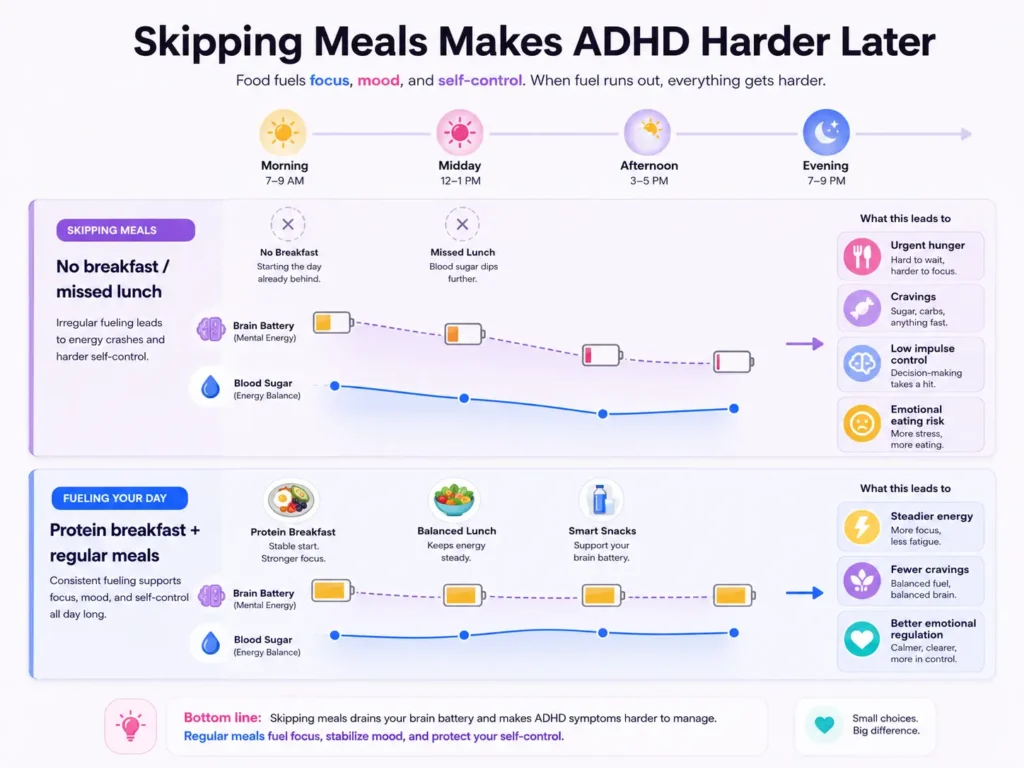
For ADHD, this matters because the prefrontal cortex is already working harder. This is the part of the brain involved in planning, inhibition, working memory, decision-making, and emotional regulation. Nutrition research has linked blood glucose fluctuations with changes in prefrontal cortex function and cognitive control, which means unstable eating can make the exact ADHD functions you rely on more fragile.
This is why the “I forgot to eat all day and then ate everything at night” pattern is so common.
By the time evening arrives, you are not making food decisions from a calm, regulated brain. You are making them from a depleted, underfed, overstimulated brain that has been borrowing executive function all day. Then we act shocked when that brain reaches for the most rewarding food in the house.
A better question is not, “Why can’t I control myself at night?”
A better question is, “What did my brain have available by the time I asked it to control itself?”
Sugar Does Not Cause ADHD, But It Can Make Your ADHD Harder to Manage
Let’s be precise because this topic gets messy.
Sugar does not “cause ADHD.” ADHD is a neurodevelopmental condition involving persistent patterns of inattention, hyperactivity and impulsivity, and major health organisations describe it as a developmental disorder, not a sugar reaction.
But that does not mean sugar has no effect on an ADHD brain.
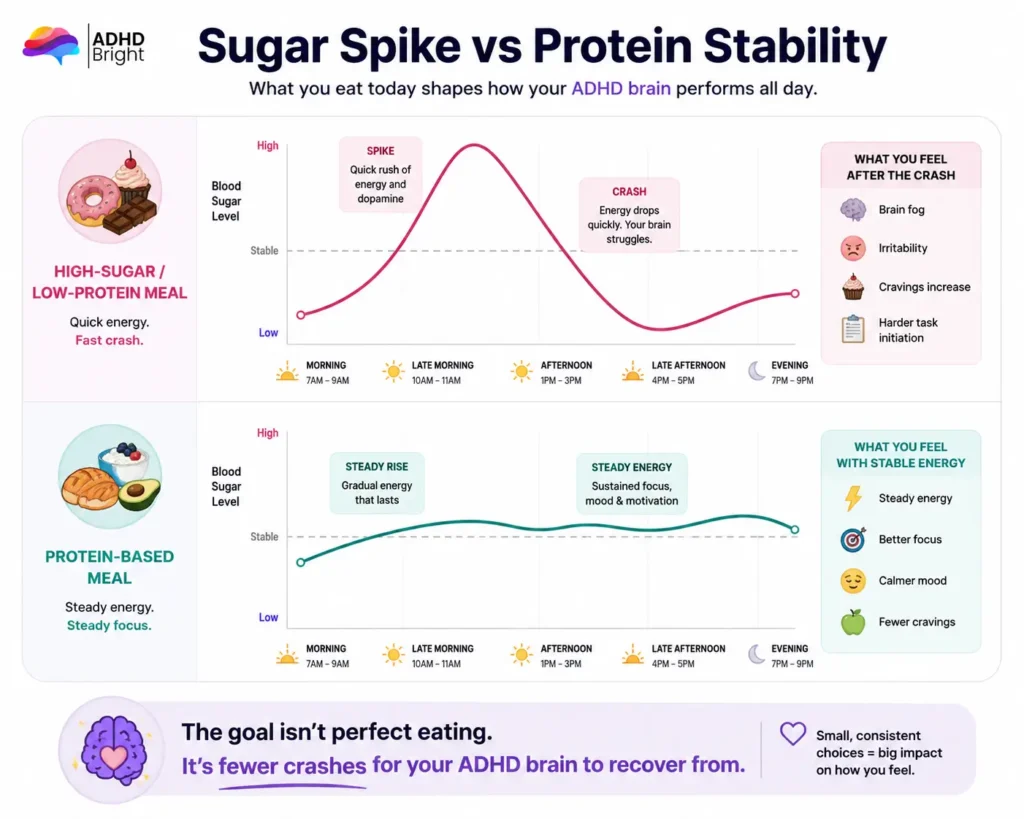
The problem is not one cookie. The problem is the pattern many ADHDers get trapped in: low protein, skipped meals, high-sugar rescue food, blood sugar spike, blood sugar crash, irritability, fog, shame, then another craving for something stimulating. This is especially powerful when the food is not just sweet but also ultra-palatable: sugar, fat, salt, texture, convenience, and novelty combined into something your reward system can lock onto very quickly.
Highly processed foods are designed to be easy to eat, fast to reward, and difficult to stop. That matters for ADHD because ADHD already involves differences in reward sensitivity, delay tolerance, impulse control, and dopamine signalling. Research on ultra-processed foods and mental health has found associations between higher ultra-processed food intake and higher odds of anxiety and depressive symptoms, although this type of nutrition research is often observational and cannot prove that processing alone is the cause.
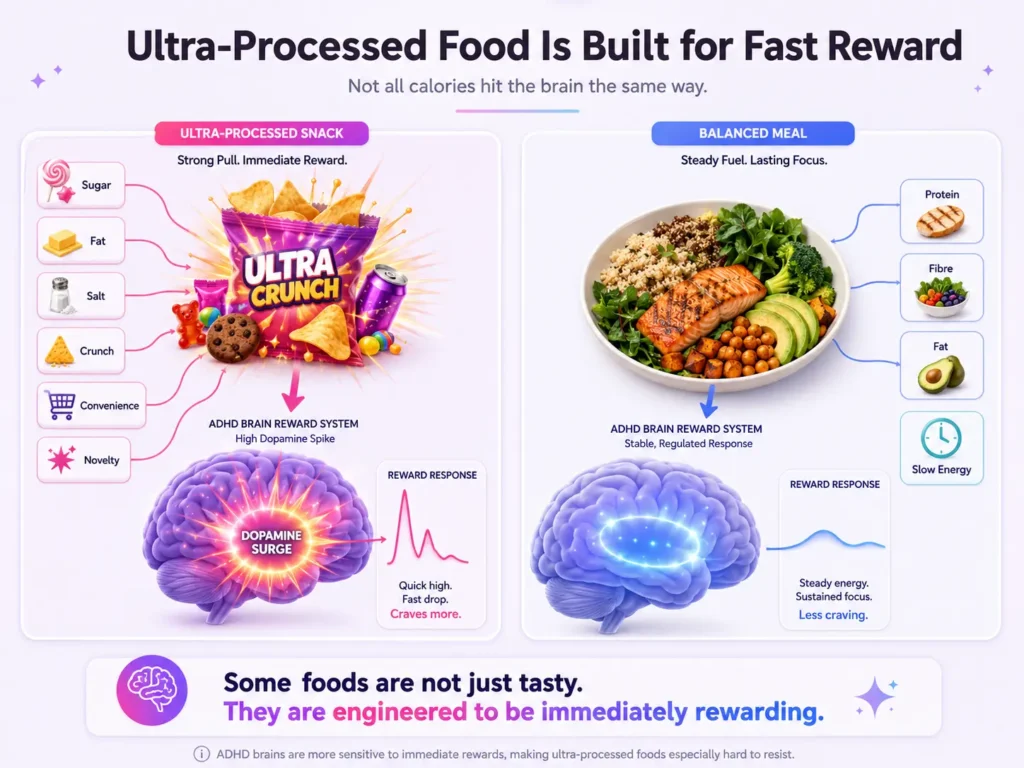
That nuance matters. The goal is not to become terrified of every packaged food. The goal is to notice what certain foods do to your regulation.
For some ADHDers, a sweet breakfast leads to a predictable mid-morning crash. For others, processed snacks become a way to stay stimulated during boring work. For others, sweets are not really about hunger at all; they are a way to change emotional state quickly. Once you see the pattern, the food stops being random. It becomes data.
And once you have data, you have a lever.
Protein Is Not a Fitness Trend. It Is Neurotransmitter Support.
Protein is often talked about like it only matters for muscle, weight loss, or gym people. For ADHD, protein matters because amino acids are part of the raw material your brain uses to build neurotransmitters.
Dopamine and noradrenaline are especially relevant for ADHD because they are deeply involved in motivation, attention, alertness, and executive function. ADHD medications work partly by increasing the availability of these neurotransmitters in the brain. Food is not medication, and it does not work in the same immediate or targeted way, but it does supply the building blocks the system depends on.
This is why a high-protein breakfast can feel so different from a sugary one. You are not just “staying full.” You are giving your brain a slower, more stable supply of energy and amino acids before the day starts asking you to focus, plan, remember, regulate, and resist distractions.
A useful ADHD rule is not “eat perfectly.”
It is: don’t let your brain start the day under-resourced.
That might look like eggs, Greek yoghurt, cottage cheese, tofu scramble, chicken leftovers, protein oats, tuna toast, a smoothie with protein, turkey slices, smoked salmon, beans, lentils, or a simple protein shake when the idea of cooking feels impossible. The best ADHD breakfast is not the one that looks impressive on Pinterest. It is the one you will actually eat before your brain starts running on fumes.
This is also why ADHD Bright includes meal planning inside the Complete version. The point is not to make people obsess over food. It is to reduce the executive load around feeding yourself, because daily meal decisions require planning, memory, shopping, timing, preparation, cleanup, and emotional bandwidth. For ADHDers, that is not “just cooking.” That is a full executive function obstacle course.
The Real Enemy Is Not Food. It Is Friction.
Most nutrition advice assumes the person can plan meals, buy ingredients, remember what is in the fridge, tolerate cooking, stop working at the right time, notice hunger early, make a balanced choice, and repeat this every day.
That assumption is ridiculous for many ADHDers.
ADHD is associated with difficulties in planning, organisation, impulse control, and sustained attention. So when nutrition advice depends on those exact skills, the advice may be technically correct but practically useless.
This is why the solution has to be lower-friction than the problem.
If feeding yourself requires too many steps, your brain will eventually choose the easier reward. Not because you do not care, but because ADHD brains are highly sensitive to friction. Every extra step gives avoidance, distraction, or impulsivity another chance to enter the room.
So the first job is not to create a perfect diet. The first job is to make the supportive choice easier to reach than the chaotic one.
That can mean keeping ready-to-eat protein in the fridge, repeating the same breakfast for a month, buying pre-chopped vegetables, using frozen meals strategically, keeping “emergency meals” on hand, ordering groceries instead of trying to survive the supermarket, or building a weekly meal plan that removes the daily question of “what am I eating?”
This is not laziness. This is executive function design.
Omega-3s, Iron, Zinc and Supplements: Useful Levers, Not Magic Fixes
Supplements are where the internet gets very annoying very quickly.
Omega-3 fatty acids are probably the most discussed nutritional supplement for ADHD. Some meta-analyses have found small but significant improvements in ADHD symptoms, especially when EPA dose is higher, while other reviews find weaker or inconsistent effects depending on which trials are included. One 2011 meta-analysis of 10 trials involving 699 children found a small but significant benefit, and a 2018 review reported that children and adolescents with ADHD had lower blood levels of omega-3 fatty acids and that supplementation showed some symptom benefit. However, a 2023 nutrition review also notes that not all omega-3 trials show significant reductions in ADHD symptom ratings.
That is the honest picture: omega-3s may help some people a little, but they are not a replacement for medication, sleep, movement, structured support, therapy, or stable eating.
Iron and zinc are also worth mentioning because they are involved in neurotransmitter function, and deficiencies can affect energy, attention, mood, and cognition. But this is exactly the kind of thing you should test rather than guess, because supplementing minerals unnecessarily can cause problems. If you suspect deficiency, especially if you have heavy periods, restrictive eating, vegetarian or vegan diet patterns, restless legs, fatigue, or hair shedding, it is worth speaking with a clinician and checking labs.
The bigger principle is this: supplements are not the foundation. Food rhythm is the foundation. Protein, regular meals, stable blood sugar, enough calories, enough micronutrients, and reduced reliance on ultra-processed dopamine rescue foods will usually matter more than adding one capsule to a chaotic system.
Binge Eating and ADHD: When Food Becomes Regulation
Binge eating is often misunderstood from the outside.
People think it is about greed, lack of discipline, or simply liking food too much. But for many ADHDers, binge eating is much more closely related to dysregulation. It can be the moment your brain finds something powerful enough to change how you feel.
If you are bored, food stimulates. If you are anxious, food soothes. If you are sad, food comforts. If you are underfed, food rescues. If you are ashamed, food numbs. If you are depleted, food gives a quick hit of reward. Highly palatable foods can do all of this very quickly, which is exactly why they can become so hard to stop once the pattern is established.
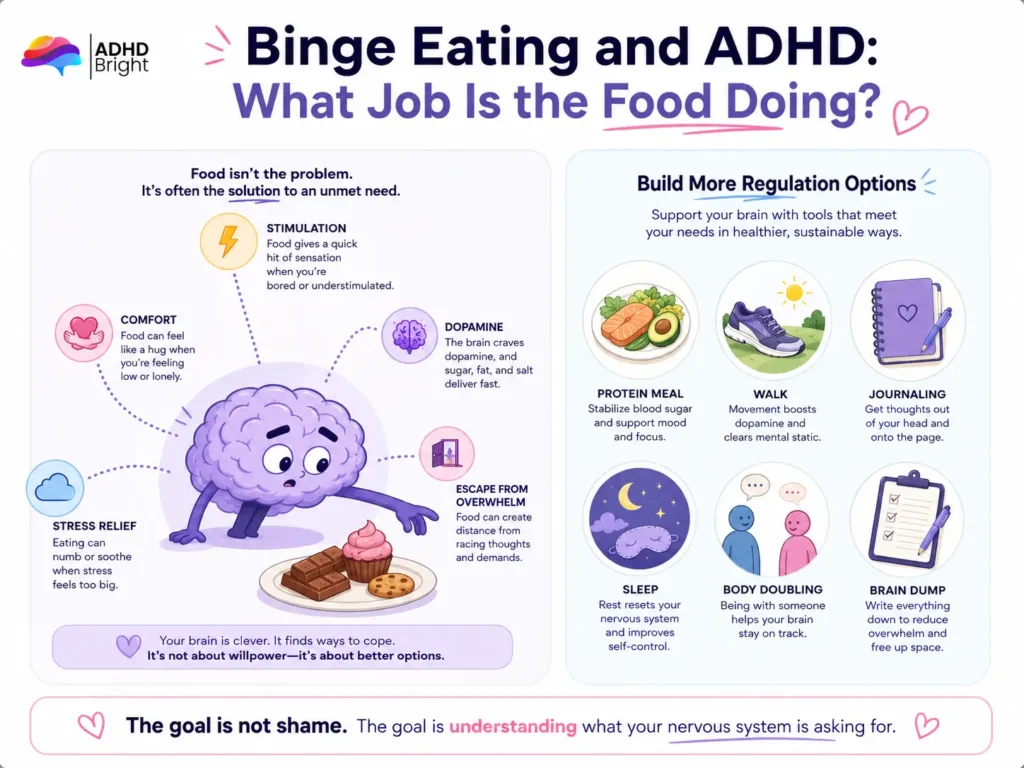
Research supports this overlap. ADHD has been associated with binge eating and emotional eating, and studies suggest ADHD is linked with a higher risk of binge-eating spectrum conditions.
This does not mean every ADHDer who overeats has binge eating disorder. It means we should stop treating ADHD-related eating struggles as a simple knowledge problem.
The question is not only, “What should I eat?”
The deeper question is, “What job is this food doing for my nervous system?”
That question changed things for me. If chocolate was the only thing that made me feel calm, rewarded, comforted, or alive at the end of a difficult day, then the problem was not chocolate alone. The problem was that my life had too few other reliable ways to regulate my nervous system.
That does not mean I could simply keep binge foods around and “mindset” my way through it. It means I had to build an environment where my brain was not constantly being asked to resist the most stimulating option while hungry, tired, emotional, and under-supported.
Your Environment Eats Your Willpower for Breakfast
A lot of people try to manage ADHD eating with willpower, and then blame themselves when it fails.
But willpower is a terrible primary strategy when the environment is stronger than your executive function. If the food that dysregulates you is visible, easy, rewarding, and available at the exact moment you are depleted, your brain has to spend energy resisting it over and over again. That is not a fair fight.
A better approach is to design the environment so the decision is easier before the craving arrives.
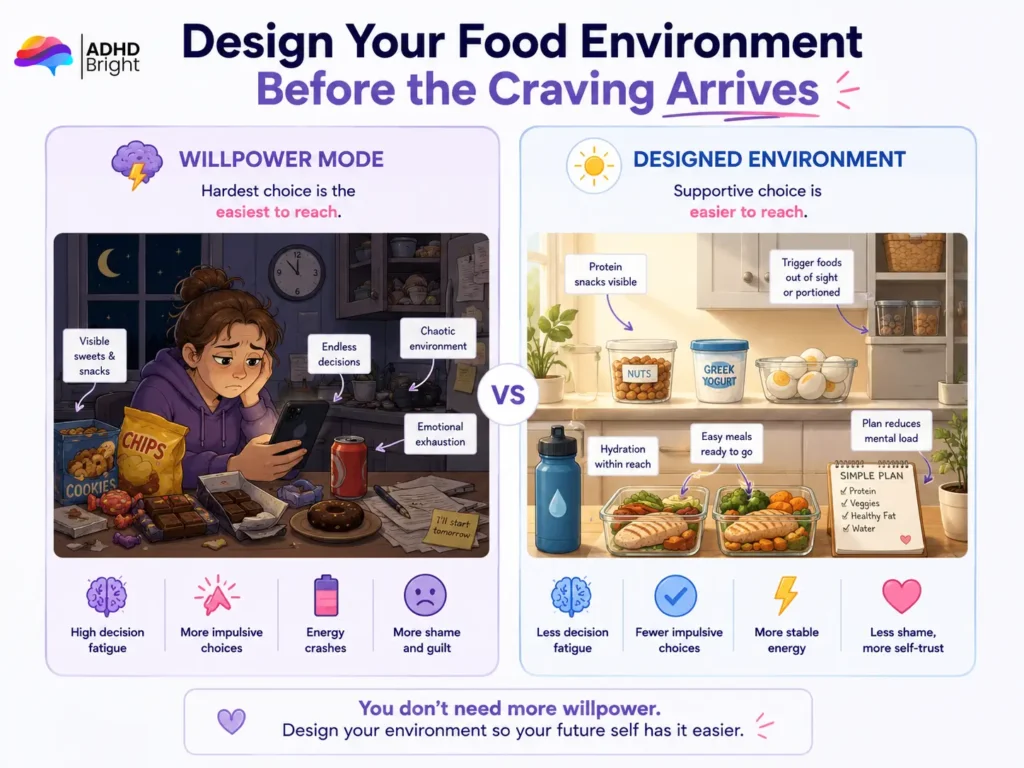
That might mean keeping trigger foods out of the house for a season. It might mean buying single portions instead of multipacks. It might mean moving sweets out of sight. It might mean putting protein snacks where you usually reach for sugar. It might mean preparing your first meal the night before because mornings are where good intentions go to die. It might mean deciding what you will eat at 3 p.m. before 3 p.m. becomes a crisis.
This is not restriction in the punishment sense. It is compassion in the design sense.
You are not saying, “I am bad and cannot be trusted.”
You are saying, “I understand how my brain responds when I am dysregulated, so I am going to stop making the hardest choice the easiest one.”
What an ADHD-Supportive Day of Eating Actually Looks Like
An ADHD-supportive way of eating does not need to be perfect, expensive, aesthetic, organic, or complicated.
It needs to be regulating.
That means your food rhythm should help your brain avoid the most common ADHD nutrition traps: long gaps without food, low protein, high-sugar crashes, decision fatigue, emotional eating spirals, and evenings where your depleted brain is suddenly expected to behave like a calm nutrition expert.
A realistic ADHD-supportive day might look like this:
Morning: Start with protein before the day becomes chaotic. Eggs on toast, Greek yoghurt with berries, protein oats, tofu scramble, cottage cheese, smoked salmon, beans, or a protein smoothie all count. This is not about being perfect; it is about preventing your brain from beginning the day underfed.
Midday: Make lunch predictable. Many ADHDers do better with a short list of repeat meals rather than endless variety. A wrap, leftovers, rice bowl, salad with protein, soup plus toast, tuna sandwich, or frozen meal with added protein is better than waiting until you are starving and then making a desperate decision.
Afternoon: Plan for the crash before the crash. If you usually lose focus or crave sugar at 3–4 p.m., treat that as a predictable pattern, not a personal failure. Try protein plus fibre or fat: yoghurt, cheese and fruit, hummus and crackers, boiled eggs, nuts, edamame, a protein bar that does not trigger overeating, or leftovers.
Evening: Reduce decision fatigue. Dinner should not require a new personality every night. Rotate a few easy meals. Batch cook if it helps, but do not force meal prep if you hate it. The goal is to have a “default dinner” that saves you when your executive function is gone.
Night: Notice whether cravings are hunger, stimulation, comfort, or habit. The solution depends on the cause. Hunger needs food. Stimulation may need a different dopamine source. Emotional distress may need regulation. Habit may need an environmental change.
This is how nutrition becomes ADHD management instead of diet culture.
For Parents: Feeding an ADHD Child Is Also Executive Function Support
For kids and teens with ADHD, nutrition can become emotionally loaded very quickly. Parents may see skipped meals, intense sugar cravings, sensory aversions, impulsive eating, picky eating, or conflict around food, and understandably worry.
The same principles apply, but with more gentleness.
A child with ADHD may not be refusing food to be difficult. They may be overstimulated, under-stimulated, sensory-sensitive, distracted, anxious, or unable to transition away from what they are doing. They may also be affected by medication timing, appetite suppression, growth needs, sleep problems, or school-day structure.
The goal is not to create fear around food. The goal is to create steady, predictable nourishment.
For many families, this means protein at breakfast, safe foods available without shame, fewer chaotic long gaps, predictable snack timing, and not using sweets as the only reward system in the house. If a child’s eating feels extreme, restrictive, secretive, binge-like, or distressing, it is worth seeking help from a paediatrician, dietitian, or eating disorder-informed therapist.
Food should support regulation, not become another battlefield.
The Simplest Starting Point: Build the First Meal
If your eating feels chaotic, do not try to overhaul your entire diet tomorrow.
Start with the first meal.
The first meal matters because it changes the trajectory of the day. It gives your brain nutrients before the demands begin. It reduces the chance of a later blood sugar crash. It lowers the odds that you will arrive at the afternoon or evening already depleted. It also gives you one repeatable win, and ADHD brains need repeatable wins more than they need dramatic resets.
Try this for seven days:
Choose one easy protein-based first meal and eat it every day. Do not make it impressive. Make it doable. Track how your focus, cravings, mood, and evening eating change. You are not tracking to judge yourself; you are collecting evidence from your own nervous system.
You might discover that a high-protein breakfast reduces your afternoon sugar cravings. You might discover that eating lunch prevents evening binge urges. You might discover that your “lack of discipline” was actually a predictable crash from under-eating.
That is the point.
Once you see cause and effect, you cannot unsee it.
Where ADHD Bright Fits In
I created ADHD Bright because ADHD brains should not have to rely on memory, motivation, and perfect consistency to take care of themselves.
Nutrition is a perfect example. Eating well requires planning, shopping, remembering, preparing, timing, cleaning, and repeating. That is a lot of executive function before you even get the benefit of the food. So instead of expecting your brain to hold all of that internally, the better approach is to externalize it.
ADHD Bright’s Meal Planner was designed to reduce food decisions, simplify meals, and make consistent eating easier. The Product Page describes the Meal Planner as a system for people who struggle with irregular meals, skipping food, forgetting to eat, and finding food overwhelming, with a weekly visual plan and 25+ ADHD-friendly, high-protein recipes.
A planner will not heal your relationship with food on its own. But it can remove friction. It can hold your meal ideas, repeat your defaults, reduce decision fatigue, and remind you that feeding yourself is not optional maintenance. It is ADHD support.
Nutrition Will Not Cure ADHD, But It Can Change the Brain You’re Managing
Nutrition is not a cure for ADHD.
It will not magically remove executive dysfunction, time blindness, emotional dysregulation, or impulsivity. Some people need medication. Some need therapy. Some need coaching. Some need eating disorder treatment. Some need bloodwork, sleep support, or medical care. None of that is a failure.
But food does change the state of the brain you are trying to manage.
A brain that is underfed, sleep-deprived, protein-poor, sugar-crashing, and overstimulated by ultra-processed reward foods is not the same brain as one that is regularly nourished, stable, and supported. You may still have ADHD in both cases, but the intensity of the symptoms can feel completely different.
That is the real reframe.
Eating better is not about becoming disciplined enough to deserve health. It is about giving your ADHD brain fewer fires to put out. It is about reducing the background chaos so your executive function has a fighting chance. It is about understanding that every meal is not a moral test; it is a signal to your nervous system.
Start small. Start with protein in your first meal. Start with not letting yourself get urgently hungry. Start with one emergency meal. Start with noticing what sugar does to your focus. Start with removing one high-friction decision.
The goal is not perfection.
The goal is to make tomorrow’s ADHD a little easier to live with.
Medical disclaimer: This article is for educational purposes only and is not a substitute for medical advice, diagnosis, or treatment. If you struggle with binge eating, purging, restriction, compulsive exercise, severe cravings, blood sugar problems, nutrient deficiencies, or distress around food, please seek support from a qualified healthcare professional or eating disorder specialist.